



Oil is getting used to the new reality
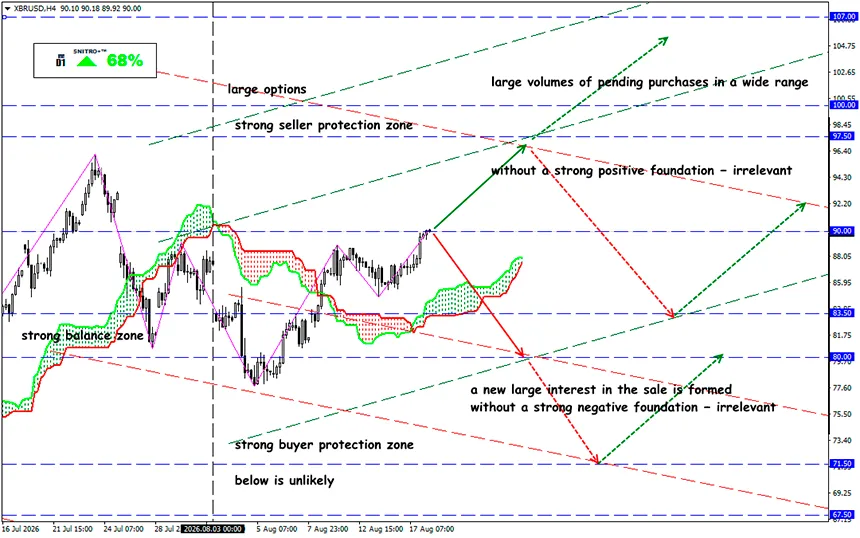
The Market is pricing in the strait of hormuz crisis
XBR/USD
Key zone: 88.00 - 91.50
Buy: 91.50 (on a decisive break above 90.00); target 93.50-95.00; StopLoss 90.80
Sell: 87.50 (on strong negative fundamentals); target 85.00-83.50; StopLoss 88.20
Supply disruptions are becoming a persistent factor putting upward pressure on prices. After six months of conflict, the chances of a diplomatic settlement appear to have been exhausted. The 60-day truce has expired, but neither the U.S. nor Tehran is showing any willingness to compromise over the future of the Strait of Hormuz.
A reminder:
Another cargo vessel was attacked today, adding yet another risk factor for this critical route for global oil and gas supplies. The shift in political expectations explains why oil prices have stabilized at around $90. Since the conflict began, oil has shed some of its “panic premium,” but it is still roughly 50% more expensive than at the beginning of the year.
The oil market is adapting — it no longer fears an immediate collapse in supplies, but neither does it expect a rapid return to normal conditions. The costs borne by both sides are simply being priced into the market.
- Tehran is no longer trying to escape the economic blockade. In July, inflation in Iran exceeded 80% compared with the same period last year. At the same time, oil exports fell to 294,000 bpd that month, compared with 1.7 million bpd in 2025.
- In the U.S., the price of diesel fuel exceeded $100 for the first time. Trump warned Americans that they need to prepare for high fuel prices. This is a highly risky admission for a president who promised lower energy prices during his election campaign. Yesterday, the average gasoline price reached $4.06 per gallon, 29% higher than a year ago.
- U.S. refineries have increased diesel production to take advantage of record-high oil prices, but domestic inventories continue to decline due to strong export demand.
- According to the IEA, due to the loss of refining capacity in the Middle East and damage to Russian facilities from Ukrainian strikes, global petroleum product processing was almost 5 million bpd lower than last year, at 81 million bpd. However, these figures may not accurately reflect actual export volumes because oil from these regions is being moved through illicit channels.
The global shortage has been partially offset by a sharp increase in U.S. fuel exports, as well as higher exports from the Fujairah terminal in the UAE and from Saudi Arabia’s Red Sea coast. However, even these alternative routes are facing problems.
There is evidence that oil producers in the Persian Gulf are increasingly relying on vessels that switch off their tracking systems while transiting the Strait of Hormuz and Bab el-Mandeb. The UAE has apparently even created a network of “shadow tankers” that transport oil through Hormuz and then transfer it in the Gulf of Oman. Risky, but profitable for now.
So, what does this mean?
An unusual situation has developed in the market: traders know that supply disruptions are occurring, but they cannot determine their actual scale. For example, UAE oil exports averaged 3.38 million bpd in August, higher than in 2025 (3.2 million bpd). However, these volumes could decline following reports of Iranian attacks on several tankers linked to the Abu Dhabi National Oil Company while they were passing through the Strait of Hormuz.
As a result, the volume of oil that actually reaches consumers has become one of the biggest uncertainties in the market. Until the situation around the Strait of Hormuz is resolved, that uncertainty will persist.
The market believes that high oil prices could persist even if crude exports stabilize, but the lack of political stability in the region limits the potential for further price increases.
The current price range around $90 looks stable, but speculative positions are accumulating near key levels at its boundaries, aiming to trigger StopLoss orders on both sides of the market whenever a new information catalyst emerges. There is still no clear medium-term trend, but an escalation of the military conflict would push prices higher in the short term.
So we act wisely and avoid unnecessary risks.


