



Oil hopes for a breakthrough
Diplomacy helps, but doubts remain
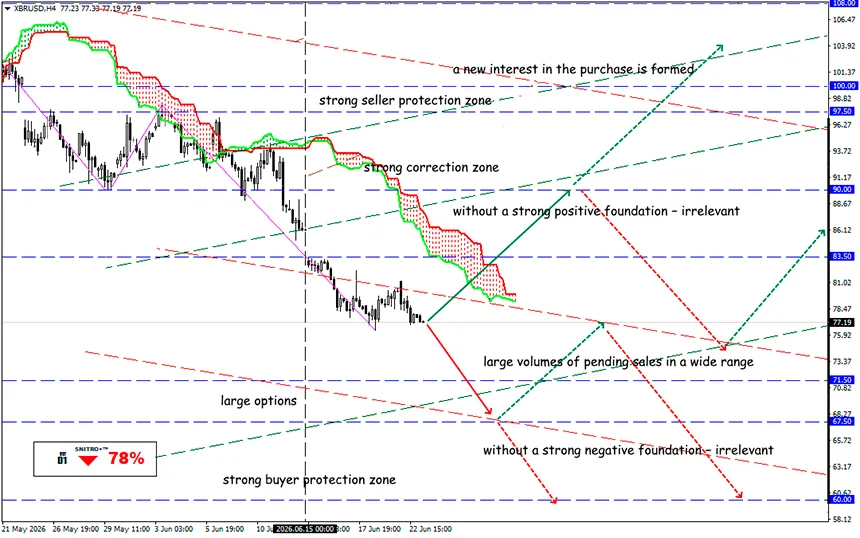
XBR/USD
Key zone: 76.50 - 80.00
Buy: 81.50 (on strong positive fundamentals); target 83.50-87.50; StopLoss 80.80
Sell: 75.00 (on a decisive break above 76.50); target 73.50-71.50; StopLoss 75.70
The oil market is declining as the risk premium continues to fall despite the resumption of traffic through the Strait of Hormuz. Investors have abandoned illusions regarding peace negotiations between the United States and Iran and doubt that the fragile diplomatic window will be able to keep one of the world's most important oil corridors open.
The war in the Middle East has long gone beyond a simple supply disruption. It has begun to undermine demand, especially in markets exposed to rising transportation, industrial, and refining costs.
Let us recall:
Brent crude futures fell by 1.85% to $76.76, while U.S. WTI crude declined by 1.74% to $72.74. This movement extended Monday's losses, when prices dropped by more than 3% after Washington granted Iran a 60-day sanctions waiver and reports indicated a pause in hostilities in Lebanon.
The sanctions waiver is expected to allow Iran to sell oil and related products on international markets during the negotiation period. This provides Tehran with short-term economic relief while the parties attempt to transform the memorandum of understanding signed last week into a long-term agreement.
In addition to efforts to restore operations in the Strait of Hormuz, the current negotiations include discussions on nuclear inspections and access to frozen Iranian assets.
- Supply risk continues to drive the market. Monitoring data showed that two crude oil tankers carrying just under 2 million barrels passed through the Strait of Hormuz on Monday. The market views tanker movements as a signal of recovering supplies and diplomatic progress.
- The gradual increase in oil flows through the Strait of Hormuz continues to put pressure on prices. Neil Crosby of Sparta Commodities noted that the market will most likely remain in a "bearish" risk-averse mood until there is a clear change in forecasts.
- Another layer of pressure comes from U.S. inventory data. Preliminary figures showed that the Strategic Petroleum Reserve (SPR) stands at 331.2 million barrels — the lowest level since June 1983 — reducing room for maneuver in the event of a major supply shock.
- In its latest monthly oil market report, the IEA lowered its 2026 oil demand growth forecast to 1.1 million barrels per day, which is 700,000 barrels per day below the previous estimate. The agency reported that supplies declined by 5 million barrels per day in the second quarter as high fuel prices and shortages of refined products negatively affected consumption.
A very large volume of oil has disappeared from the market. Estimates vary significantly because part of the volumes were secretly transported along the coast of Oman during the closure of the strait. Nevertheless, the drivers of further price declines currently outweigh the bullish factors:
- Increased production by non-OPEC countries has been recorded in response to supply shortages — particularly in South America and Canada. The United States has become the world's largest exporter for the first time.
- After the strait reopens, large volumes currently stored on tankers will return to the market.
- Iran will be able to increase production if sanctions are lifted (which is explicitly stipulated in the memorandum).
- The current situation may force OPEC+ to compete for market share and increase production.
The restoration of traffic through the Strait of Hormuz should normalize the supply-demand balance if no new force majeure events occur. However, the market will not be able to transition smoothly from shortage to surplus.
And what is the result?
Skepticism regarding the situation has not disappeared. Trump warned that he would take tough measures if Iran failed to comply with the agreement, while Iranian officials disputed U.S. Vice President J.D. Vance's statement that Tehran had agreed to allow nuclear inspectors back into the country.
The market is likely to remain unstable in the coming months. Against the backdrop of critically depleted commercial inventories, the market is demonstrating extreme sensitivity to geopolitics. Any military-risk impulse — from the collapse of the Swiss agreements on Iran to harsh declarations at the Ankara summit or incidents in the Persian Gulf — will immediately be interpreted by investors as a trigger for higher prices. An impulsive breakout above the upper boundaries of the current trading range could quickly push Brent toward $86–88 and WTI toward $81–83.
So we act wisely and avoid unnecessary risks.
Profits to y’all!


