


Norway’s oil fund: honest business and sensible risk-taking
The Sovereign wealth fund posts record profits
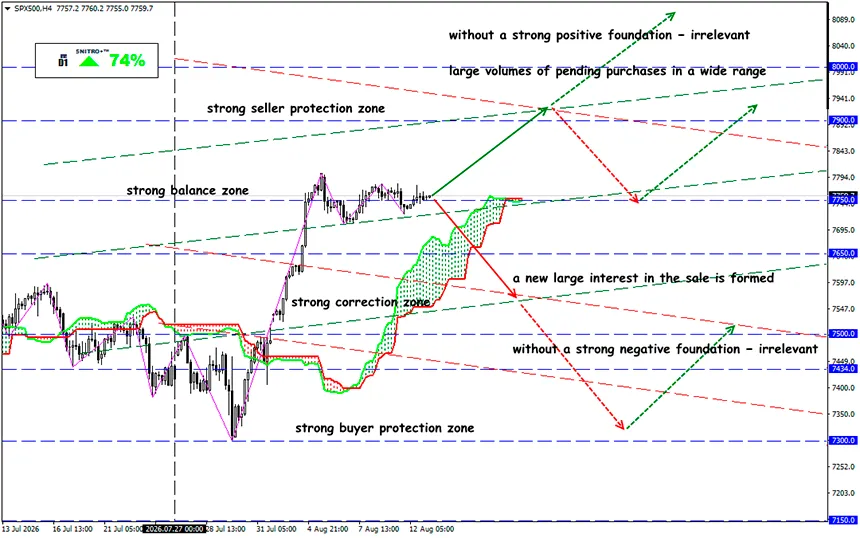
SP500
Key zone: 7,700 - 7,820
Buy: 7,850 (after retesting 7,800); target 8,000-8,050; StopLoss 7,800
Buy: 7,850 (after retesting 7,800); target 8,000-8,050; StopLoss 7,800
Norway provides an example of how state capital can be transformed into a long-term investment resource through a combination of professional management, clear rules, and sensible government oversight. The state does not attempt to manage every investment decision itself. Instead, it establishes a clear mandate, monitors compliance with the strategy, and gives professional asset managers the autonomy they need.
A reminder:
Norway’s Government Pension Fund Global, managed by Norges Bank Investment Management (NBIM), posted a record result in the first half of 2026. The investment portfolio returned 9.4%, while investment profit reached NOK 1.753 trillion, or about $184.3 billion.
For comparison, the fund returned 15.1% for the full year 2025, while its average annual return since 1998 has been around 6.6–6.9%, depending on the calculation period. This means the result for the first six months of 2026 is significantly above its long-term average pace.
Norway’s oil fund was created to invest the country’s oil and gas revenues for the long term. NBIM manages the assets, while Norway’s Ministry of Finance determines the overall investment strategy.
The key principle of the model is global diversification with a relatively low level of active deviation from the benchmark index.
- The fund invests exclusively outside Norway to avoid putting excessive pressure on the domestic economy.
- The portfolio includes equities and bonds, as well as limited allocations to unlisted real estate and renewable energy infrastructure.
- NBIM uses three main approaches to portfolio management: broad market allocation, individual security selection, and capital allocation across asset classes.
- The fund is not a conventional actively managed portfolio. A significant share of its performance is driven by movements in global markets. This is particularly important when assessing the record profit in 2026: it cannot be interpreted entirely as the result of successful individual stock picking.
As of the end of July, the portfolio includes around 7,100 companies, while the fund’s average ownership stake in publicly listed companies worldwide is approximately 1.5%.
Technology stocks made the largest contribution to performance — the rally in Asian semiconductor manufacturers, including Taiwan Semiconductor Manufacturing, Samsung Electronics, and SK Hynix, proved particularly profitable.
As of June 30, the fund’s largest position was Nvidia — approximately $62 billion. It was followed by Apple at $52 billion, Alphabet at $50 billion, Microsoft at $35 billion, and Taiwan Semiconductor Manufacturing at $34 billion. Combined, the ten largest companies now account for roughly 20% of the fund’s value, with most of them belonging to the technology sector.
The fund’s investment performance must be distinguished from changes in its value measured in Norwegian kroner. The strengthening of the national currency reduced the fund’s value by approximately NOK 427 billion. The fund invests primarily in foreign assets and therefore has significant currency exposure. Movements in the krone can materially change the portfolio’s value in domestic currency even when the underlying asset prices do not move accordingly.
So, what does this mean?
The Norwegian fund delivered exceptionally strong profits — an excellent case for study and analysis, but the result should be viewed as a consequence of powerful gains in global equities, particularly in the Asian technology and semiconductor sectors.
The NBIM model remains predominantly index-based and diversified, which means the fund does not make large bets on individual companies. For a long-ter
So we act wisely and avoid unnecessary risks.
Profits to y’all!


