



New trend: the crisis of capital logistics

What to trade during a war
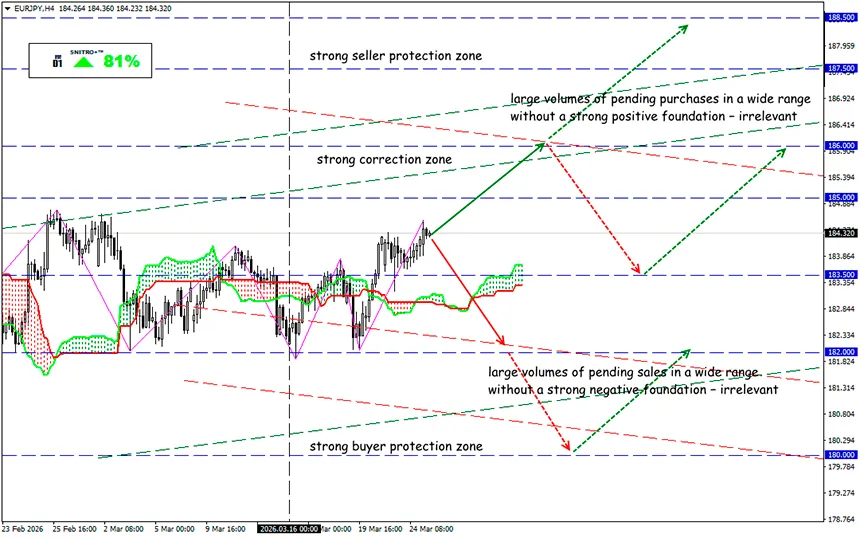
EUR/JPY
Key zone: 183.50 - 185.00
Buy: 185.30 (on a decisive break of 185.00); target 187.50; StopLoss 184.70
Sell: 183.50 (on a strong negative fundamental) ; target 181.50-180.00; StopLoss 184.20
The war is threatening capital flows from the Persian Gulf countries. The need of these countries for financing may significantly affect the global financial market, even if the long-term stability of the region is not disrupted.
Strikes on energy infrastructure are no longer geopolitics — this is already a systemic risk.
Reminder:
The leading GCC countries (Gulf Cooperation Council) — Bahrain, Kuwait, Oman, Qatar, Saudi Arabia and the UAE — have long become a key element of the global financial system. Over the past four years, their total current account surplus exceeded $800 billion.
Over the past 5–7 years, sovereign funds of the Persian Gulf countries have been the largest driver of global liquidity:
- investments in technology companies,
- massive investments in infrastructure in Europe and Asia,
- active expansion into Africa,
- growth of private equity and venture capital.
Any changes in global capital flows are taking place at a time when the world economy is facing serious challenges. Large budget deficits in developed countries and the need to refinance debt obligations are stimulating bond issuance worldwide.
This may become the main macro trend of 2026–2027 for traders.
The capital world is facing not a “risk of war”, but the fact of war. The most serious threat right now is not oil (production will still recover!), but the outflow of capital from the Gulf countries.
Any regional war automatically redistributes the budget — defense, infrastructure protection, insurance and logistics security. This means: money that previously went into foreign investments begins to remain inside the region.
And if the region becomes (or may become) a combat zone, capital begins to search for new centers of safety.
Right now the market is not trading the “risk of conflict”, but a physical energy shock:
- Europe has already seen gas prices jump by +35% in one week;
- oil moved above $100 and then collapsed by 11% in just one day on news of negotiations;
- countries in the region officially declared at the UN a threat not only to energy but also to financial infrastructure;
- analysts call what is happening a crisis of energy security and warn of the risk of an inflation shock.
After strikes on energy infrastructure, the market has switched into a classic risk-off + energy shock mode:
- the dollar strengthened as a safe-haven currency,
- the euro began to fall due to rising gas prices in Europe,
- currencies of energy-importing countries came under pressure.
If the conflict drags on, the following is possible:
- a slowdown in investments from funds of Saudi Arabia, the UAE and Qatar,
- a reduction in financing for large international projects,
- a sell-off of liquid assets to cover budget spending.
If inflation accelerates again, central banks will postpone rate cuts, growth stocks will once again come under pressure, and gold and oil will receive a second impulse.
If oil remains high for at least 3–4 months — commodity currencies win, Europe and Asia lose.
The main trend is the divergence between currencies of energy-exporting and energy-importing countries.
If the conflict lasts more than 3–6 months, capital relocation to “safe centers” may intensify: the US (dollar and Treasuries), Switzerland, Japan, commodity countries outside the conflict zone.
The main victims of the capital crisis will be growth stocks, markets dependent on investments from Middle Eastern countries, technology venture assets, and European real estate.
The most promising in the medium term will be cross-assets involving the yen: EUR/JPY, GBP/JPY.
Usually the JPY rises during crises, but now the situation is different:
- Japan is highly dependent on energy imports,
- rising oil worsens the trade balance,
- the Bank of Japan continues a “soft” policy.
Therefore, an atypical scenario is possible: USD rises against both EUR and JPY at the same time.
So we act wisely and avoid unnecessary risks.
Profits to y’all!


