



New tariffs on China
Trump declares war on Chinese drones
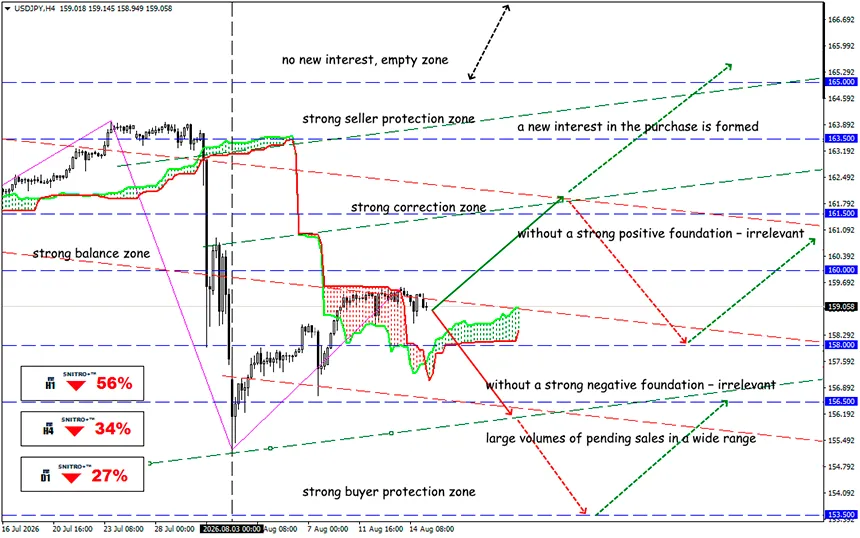
USD/JPY
Key zone: 159.00 - 160.00
Buy: 160.50 (on a confident break of 159.80–160.00) ; target 162.50-163.50; StopLoss 159.80
Sell: 158.00 (on strong negative fundamentals) ; target 156.50-155.00; StopLoss 158.70
The U.S. is stepping up pressure on China’s technology industry. Trump is imposing new tariffs on imports of drones and components, with the maximum rate reaching 100%. The move is formally framed as a national security measure, but the real goal is to break Beijing’s dominance in the drone market.
The tariffs are intended to force manufacturers to shift supply chains to the U.S. and gradually push China out of a critical market segment.
A reminder:
The toughest restrictions — 100% of the product’s value — are expected to apply to larger models equipped with technologies that have potential military applications, including thermal imaging equipment, as well as certain critical components. For smaller drones and components that are not considered a “national security threat,” the tariff will be 25%.
Allies, naturally, will receive preferential treatment. Products from the EU, Japan, Liechtenstein, South Korea, Switzerland, and Taiwan will face a 15% tariff, while the rate for the United Kingdom will be 10%. However, the preferential rate will apply only if requirements regarding the origin of equipment, software, and technology are met.
And this is no longer just about tariffs.
- The new measures are based on Section 232 of the Trade Expansion Act of 1962.
- Legally, this mechanism appears more resilient than many other trade measures introduced by the Trump administration. For example, the Supreme Court’s February ruling that struck down a number of global tariffs did not affect restrictions imposed under Section 232.
- Washington has already used this instrument against steel, aluminum, automobiles, and auto parts. Now drones have been added to the list of strategic industries.
Washington is not simply closing off its market — it is simultaneously trying to create a domestic producer. If China controls a significant share of the global commercial drone market, the tariff is supposed to make Chinese products less competitive and U.S. manufacturing more economically attractive.
From a defense industry perspective, such a move looks logical: drone tariffs fit into a much broader U.S. strategy to reduce dependence on Chinese technology. Critical technology must be produced domestically or within a controlled supply chain involving allies.
For China, the problem extends beyond this specific market. The main risk is not the size of any particular tariff. Under such a system of restrictions, it becomes increasingly difficult for Chinese companies to simultaneously sell their products, gain access to U.S. technology, raise capital, and participate in Western supply chains.
That is precisely why the timing of the new tariffs carries additional significance: the decision was made ahead of the expected meeting between Trump and Xi Jinping on September 24.
So, what does this mean?
For U.S. manufacturers, this is a potential opportunity to gain a protected domestic market. For consumers, it means the risk of higher prices for drones and components. For Chinese companies, it is yet another blow to their access to the world’s largest market.
Insiders believe the drone tariffs will take effect 21 days after the declaration is signed. A 180-day transition period is предусмотрен for noncritical components.
The main takeaway for the market is obvious: Washington is no longer trying simply to restrict China. It is building a technological perimeter around the U.S. economy. And drones are just the latest front in this new trade war.
So we act wisely and avoid unnecessary risks.
Profits to y’all!


