



How the New Market Reaction Breaks Traditions

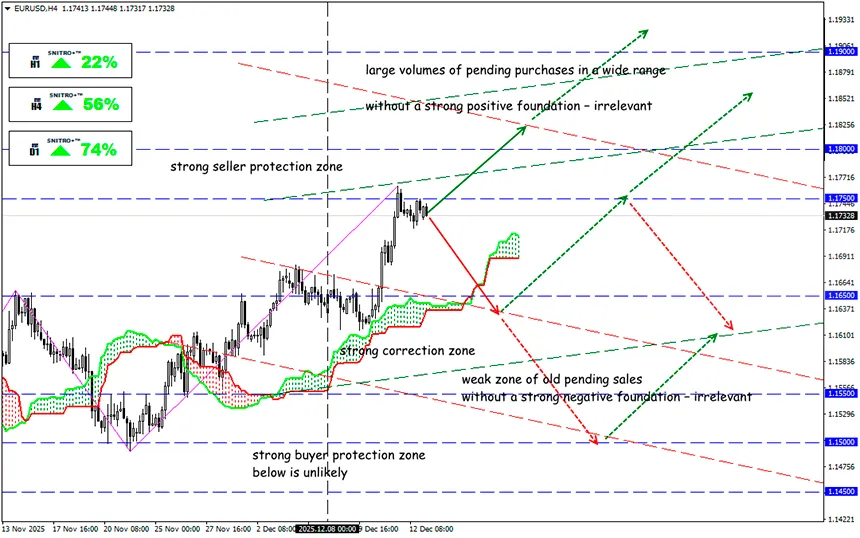
The Fed Is No Longer the Main Driver
EUR/USD
Key zone: 1.1700 - 1.1750
Buy: 1.1780 (on a confident breakout of the 1.1750 level) ; target 1.1900-1.1950; StopLoss 1.1720
Sell: 1.1680 (on strong negative fundamentals) ; target 1.1550-1.1500; StopLoss 1.1740
The past week was packed with fundamental events, but whereas previously the Federal Reserve was the key market driver — especially after its scandalous launch of a QE-like mechanism just 12 days after ending QT — the market is now reacting far more selectively.
The Fed’s decision will, of course, be felt by the market: it implies liquidity injections of around $40 billion per month, at least through April. Such a rapid pivot from QT to QE signals serious stress within the banking system. In theory, QE should be a medium-term positive for currencies and equities. So far, however, only the dollar has reacted — and even that reaction has been weak, largely due to renewed panic around AI-related assets.
An event comparable in importance to the Fed itself is Donald Trump, who unexpectedly stated that he has not yet decided between two Kevins — Hassett and Warsh. Trump will clearly be watching market reactions closely, periodically floating new names for the Fed chair role.
It is obvious that Trump dreams of a fully controllable Fed (as in Turkey) or at least one similar to Japan’s, but for now there are no real grounds for such a scenario.
The conclusion is straightforward: capital should move toward real money (the dollar), not illusions (the euro).
Next week, US macro data will once again be in the spotlight. Key drivers for the dollar will be the NFP report on December 16 and US consumer inflation data on December 18.
Recall that Powell has repeatedly stated the Fed is not opposed to rate cuts if inflation convincingly returns to the 2% trajectory.
If the US enters a new disinflationary phase and the labor market continues to cool, this would provide a strong foundation for a shift toward a more accommodative policy stance — and give market participants additional reasons to sell the dollar.
NFP may put pressure on the US currency, while CPI data could partially rehabilitate it.
If both ADP and NFP reports come in negative, euro buyers are likely to consolidate above the 1.1750 resistance level and attempt a move toward 1.1800. If the data beats expectations, EUR/USD could fall toward 1.16 or lower.
Following the EU’s decision on frozen assets and broader market dynamics, the reaction to the ECB’s rate decision may be distorted. Historically, the peak of year-end capital repatriation ends around December 15–20, but if the fundamental backdrop for the euro deteriorates, the decline could start earlier.
Geopolitical risks for the euro remain extremely high, and its rally could be interrupted by expected or unexpected news at any moment.
So we act wisely and avoid unnecessary risks.
Profits to y’all!


