



Money Never Disappears — It Just Changes Direction

Which Stocks Rise During War
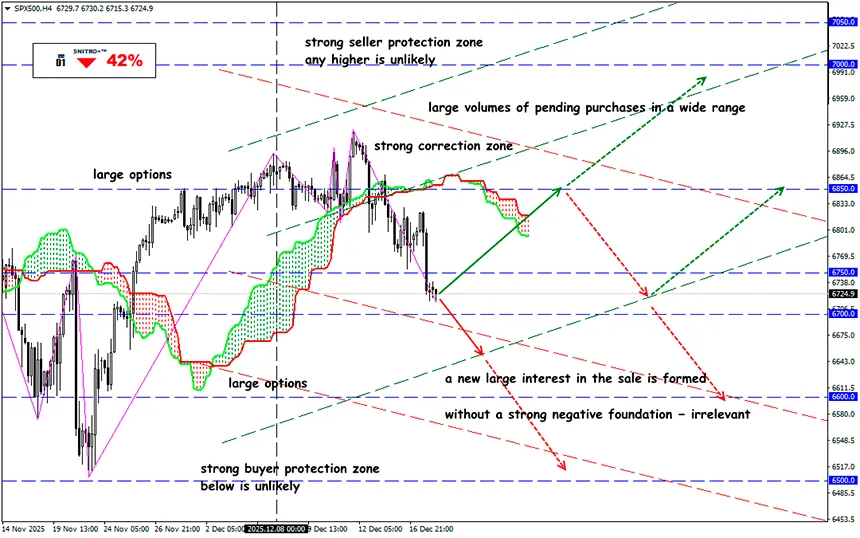
SP500
Key zone: 6,700 - 6,750
Buy: 6,800 (on strong positive fundamentals); target 6,950-7,100; StopLoss 6,720
Sell: 6,700(after retesting the 6,800 level); target 6,550-6,500; StopLoss 6,780
Military conflicts reshape global demand by reallocating capital across sectors. For investors, this is not chaos but a set of patterns that can be monetized — provided one understands the risks and the logic behind capital flows.
Markets perceive war as a source of uncertainty, yet history shows that even during major conflicts certain segments of the economy not only survive but outperform the broader market.
Governments increase defense spending, energy markets face supply shortages, supply chains are rebuilt, and demand for security, raw materials, and essential goods rises.
An investor who can separate emotion from analysis can use these structural shifts to their advantage.
This is not about news-driven speculation or trying to predict the outcome of conflicts. The focus is on time-tested market models observed during World War I, World War II, the Cold War, regional conflicts in the Middle East, and modern geopolitical crises.
Key principles for investing in stocks during wartime:
- Monitoring government spending: defense budgets, long-term contracts, expansion of state orders regardless of the economic cycle.
- Analyzing real shortages, not headlines: logistics disruptions, rising energy and commodity prices, tariff pressure.
- Focusing on “mandatory demand” for energy, food, security, and core infrastructure.
Major stock segments that historically outperform or remain resilient during wars and geopolitical escalation:
- Defense & aerospace stocks Companies receive large government contracts and experience elevated demand during conflicts. Examples: Lockheed Martin; Boeing Defense; Northrop Grumman; General Dynamics; BAE Systems; Elbit Systems
- Energy sector Conflicts increase supply-chain risks for hydrocarbons, driving prices higher and supporting profits. Exxon Mobil; Chevron; Occidental Petroleum; Venture Global LNG; TotalEnergies
- Cybersecurity Military conflicts intensify cyberattacks and investment in digital defense. Palo Alto Networks; CrowdStrike Holdings; Fortinet; Zscaler; SentinelOne; Tenable; CyberArk Software
- Gold During crises, investors seek refuge in gold (including mining stocks); both spot prices and ETFs tend to rise. SPDR Gold Shares (ETF); Barrick Gold; Newmont Corporation; Kinross Gold
- Infrastructure & construction materials Post-conflict reconstruction supports demand for equipment and materials. Caterpillar; Vulcan Materials; Martin Marietta
Also relevant:
- Commodities and basic materials
- Food and agricultural companies
- Insurance companies and strategic hedge funds
Reminder: this is not investment advice, but analytical information only.
Profiting from stocks during war is possible not because “war is good,” but because markets price cash flows, contracts, and expectations — not moral judgments. This is not a bet on catastrophe, but a rational assessment of economic restructuring. That understanding separates successful investors from the crowd.
So we act wisely and avoid unnecessary risks.
Profits to y’all!


