



Mirages of victory and real problems
Why the illusion of global control is dangerous
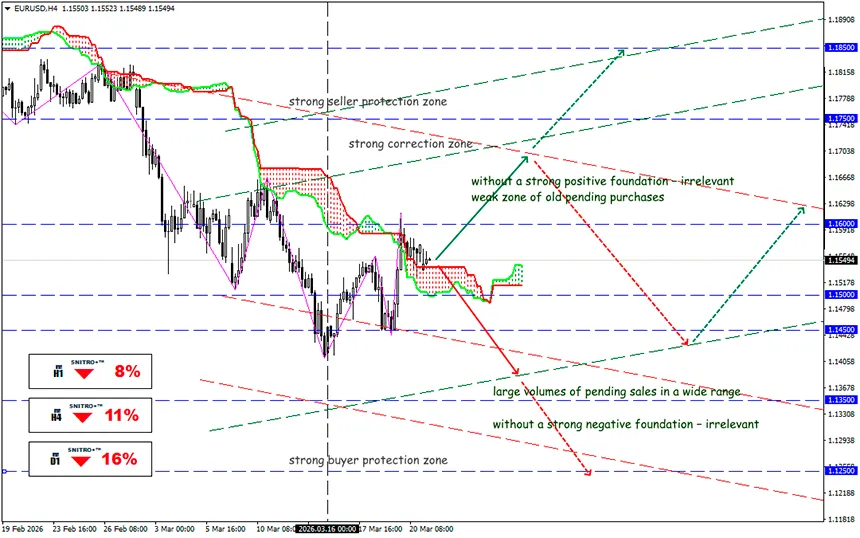
EUR/USD
Key zone: 1.1500 - 1.1600
Buy: 1.1620 (on strong positive fundamentals) ; target 1.1750; StopLoss 1.1560
Sell: 1.1500 (on a pullback following a retest of the 1.1550 level) ; target 1.1350; StopLoss 1.1560
The range of emotions from “we have won” to “we do not need this strait” in Trump’s statements about the situation in Iran looks like an attempt to convince the markets that the physical blockade of a key transport artery has no significance for the United States. In reality, Trump simply did not expect such global problems from his political adventurism.
The laws of partnership — both political and military — are no longer relevant at the moment.
The demands directed at NATO, Europe, Japan, and South Korea to deal with the blockade problem on their own are a weak attempt to admit that the United States cannot guarantee the security of shipping alone. Trump stated that his country will not guard the Strait of Hormuz — control must be exercised by consumer states. Donnie is trying to shift responsibility for a situation that he himself failed to stabilize in three weeks onto his allies.
- We are witnessing a radical change in the global role of the United States.
- If earlier the United States was a guarantor, now it is only a “consultant on demand”.
- For the global economy this means a sharp increase in insurance premiums and the militarization of trade routes.
- The current conflict has shown that US military power is losing to asymmetric economic pressure.
At the moment, the Strait of Hormuz is open only for “episodic” passages in the interests of China and India (1.0–1.5 million barrels per day). Tehran has turned the war into a routine that the global economy simply cannot afford.
The absence of control over the waters of the Persian Gulf directly dictates the economic cost of the conflict.
Diplomatic channels are also ineffective: any attempts to discuss the resumption of the operation of the Strait of Hormuz run into a wall of silence.
Timing is working against the White House. Every day of the blockade of the Strait of Hormuz does not strengthen, but destroys the US position.
Only verbal manipulations remain, which can no longer hide the cascading collapse of the global system.
The real catastrophe is hidden in inter-industry connections.
- Pharmaceuticals (a sharp reduction in drug production in India; shortage of packaging and syringes).
- Textile industry (collapse of polyester production in China and Bangladesh, export shock in Asia).
- Electronics (shortage of raw materials at TSMC and Intel factories, the end of the “chip rally”).
- Food sector (shortage of fertilizers, fuel, rising cost of packaging and freight).
- The technology sector is being sacrificed to oil: NASDAQ 100 fell by more than 2.5%, high energy prices have begun to burn out investments in AI.
The fear index VIX jumped by 20%, reflecting a complete loss of reference points.
Treasury Secretary Bessent announced a decision that a month ago seemed unthinkable: the United States is temporarily lifting restrictions in order to bring 140 million barrels of Iranian oil to the market.
In fact, traders are trading sentiment in the Oval Office, not real data. Trump hopes that Iranian barrels will push prices down before panic among US consumers becomes uncontrollable.
The probability of Trump’s impeachment already this year has jumped to 72%.
In this chaos, the currency market is behaving strangely: the euro is showing strength, while the dollar, contrary to the logic of the oil rally, has begun to lag behind. The ECB has found itself in a situation where it must develop new plans to fight a catastrophe that has already begun. Europe is entering a period of prolonged inflation and low growth, where monetary tools are powerless against a blocked Strait of Hormuz and burning refineries. Technical analysis is practically not working — the currency reacts only to the information background.
So we act wisely and avoid unnecessary risks.
Profits to y’all!


