



Life on the edge between tariffs and geopolitics
Why the market is no longer afraid of trade wars
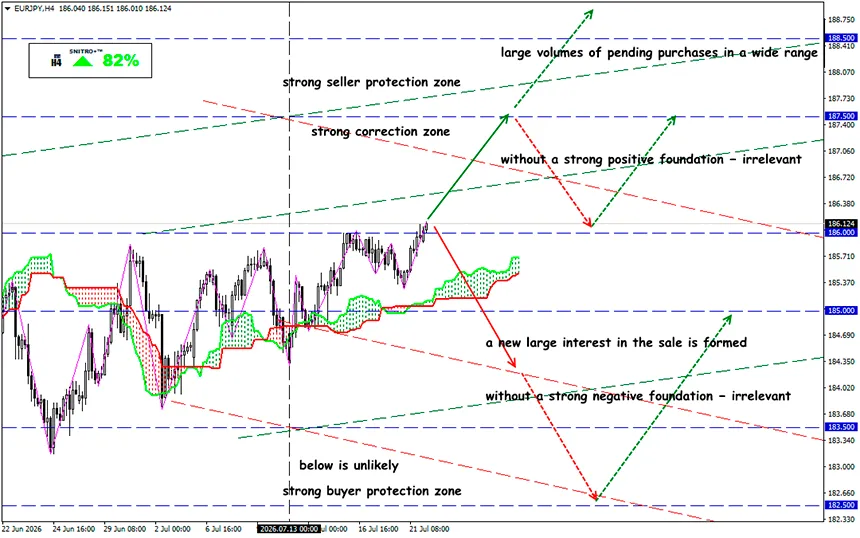
EUR/JPY
Key zone: 185.00 - 186.00
Buy: 186.50 (on a pullback following a retest of 186.00); target 187.50-188.20; StopLoss 185.80
Sell: 185.00 (on strong negative fundamentals) ; target 183.50; StopLoss 185.70
Just a year ago, news of new U.S. trade tariffs could reshape sentiment across virtually every major financial market within hours. Today, another wave of U.S. import duties is no longer triggering panic. The foreign exchange market has fundamentally changed the way it assesses risk: for the euro, the pound sterling, and the Japanese yen, inflation trends, Federal Reserve decisions, oil prices, and geopolitical tensions now matter far more than individual tariff announcements.
However, the combination of these factors could provide the market with a new source of momentum.
Following the U.S. Supreme Court's decision limiting the scope of broad-based tariffs, the Trump administration introduced a temporary 150-day import duty in February 2026 under Section 122 of the Trade Act. That period expires at the end of July, after which the White House plans to replace it with a new system of long-term tariffs covering nearly all U.S. imports.
This represents the most significant change in U.S. trade policy in recent years. The new tariffs could affect approximately 99% of U.S. imports. Rates for most countries are expected to range between 10% and 12.5%, while selected product categories will face even higher duties.
A 10% tariff is planned for a dozen major trading partners, including the European Union, Mexico, and Canada. Tariffs of 12.5% will apply to roughly forty countries, including China, India, Japan, and South Korea. Of course, surprises remain possible. However, there is a strong possibility that this tariff sequel will prove far less alarming than the original version—and financial markets may simply ignore it.
In the spring of 2025, markets initially viewed import tariffs as a catalyst for higher inflation. U.S. Treasury yields climbed, the U.S. dollar strengthened, and expectations for Federal Reserve rate cuts were almost completely repriced.
However, within just a few weeks, market sentiment changed.
Experience has shown that a significant share of the tariff burden ultimately falls on U.S. importers and consumers. Rising import costs begin to weaken consumer demand, reduce corporate profitability, and weigh on economic growth. As a result, investors increasingly view broad tariffs as a long-term disinflationary factor through slower economic activity rather than solely as a driver of higher prices.
This explains why market participants now evaluate trade restrictions very differently: the greater the pressure on the U.S. economy, the higher the probability that the Federal Reserve will eventually adopt a more accommodative monetary policy.
- Geopolitical developments are once again becoming the primary market driver: any threat to oil shipments through the Strait of Hormuz immediately increases the geopolitical risk premium embedded in crude oil prices.
- Brent crude continues to trade well above its long-term average, while every additional $10 per barrel has the potential to add roughly 0.2–0.4 percentage points to inflation in developed economies over the course of several quarters. Consequently, developments in the Middle East now have the potential to generate substantially greater market volatility.
- At the same time, the euro also has strong fundamental support. Economic expectations in Germany continue to improve amid anticipation of large-scale fiscal investment, infrastructure spending, and tax reforms proposed by Chancellor Friedrich Merz's government.
What does this mean?
The European Central Bank believes that further monetary easing could proceed much more gradually than expected only a few months ago. If inflation in the euro area remains close to target while Germany's economy gradually recovers, the interest rate differential between the United States and Europe may stop widening.
From a fundamental perspective, markets remain in a waiting mode. Until new U.S. inflation data, labor market reports, and subsequent comments from Federal Reserve officials are released, the probability of continued consolidation remains high.
If the new U.S. tariff policy proves significantly more restrictive than markets currently expect, the initial reaction across all currency pairs could be sharp. However, the longer-term market direction will depend on how the new tariff regime changes expectations for inflation and future Federal Reserve policy decisions.
So we act wisely and avoid unnecessary risks.
Profits to y’all!


