



Jackson hole will determine the Dollar’s trend
Kevin Warsh’s first test drive
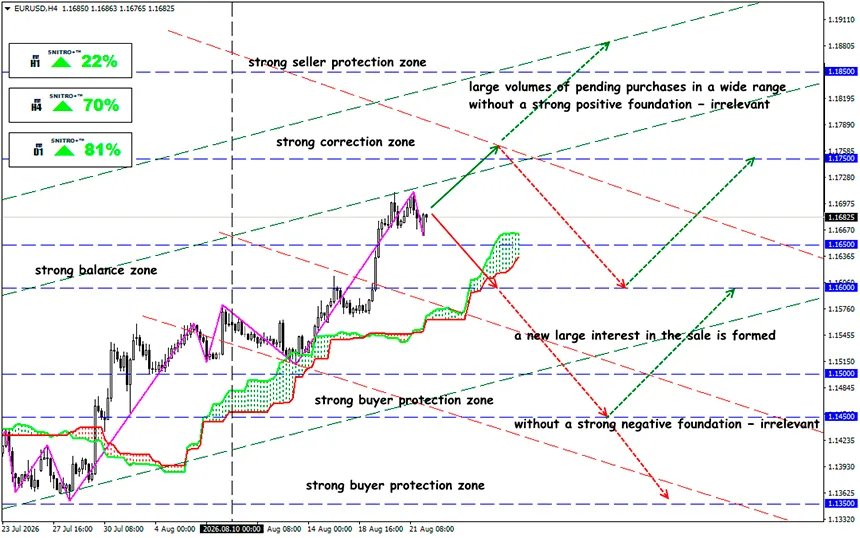
EUR/USD
Key zone: 1.1650 - 1.1750
Buy: 1.1750 (on a decisive break above 1.1730) ; target 1.1950-1.2000; StopLoss 1.1680
Sell: 1.1600 (on strong negative fundamentals) ; target 1.1450-1.1350; StopLoss 1.1670
A contradictory situation is developing for the dollar. On the one hand, mixed U.S. economic data and expectations of a more dovish Fed are limiting the dollar’s upside potential. On the other hand, the ongoing conflict in the Middle East is supporting demand for the U.S. currency as a safe-haven asset.
The Dollar Index (DXY) started the new week under pressure, remaining near three-month lows.
A reminder:
The latest data failed to provide unequivocal support for the dollar. U.S. business activity data released on Friday were mixed. The uneven nature of U.S. data is currently preventing the market from developing sustained demand for the greenback. The U.S. economy is not yet showing signs of a sharp deterioration, but there are also increasingly fewer arguments in favor of further Fed tightening.
- The August Manufacturing PMI fell to 53.2 from 53.9 previously and came in below expectations.
- At the same time, the services sector looked significantly better: the PMI rose to 56.8 from 54.6, while the Composite Index climbed to 56.0 from 54.5 a month earlier.
- The deterioration in manufacturing prevented the data from becoming an unequivocally positive factor for the dollar.
- Treasury yields remain a critical source of pressure on the dollar: the 30-year yield remains near multi-year highs.
This is precisely why the market is now closely watching not only the Fed’s actions but also the U.S. Treasury’s ability to control the situation in the government debt market.
Treasury buybacks can support bond prices and push their yields lower. For the dollar, this means weakening one of its main “magnets” — the interest-rate advantage of U.S. assets. It also raises a more troubling question: is the Treasury trying to manage borrowing costs at a time when investors are demanding an increasingly large premium for fiscal risk?
It was precisely this shadow of doubt that hit the dollar harder than the size of the program itself. If the market sees the buybacks as an attempt to hold down long-term rates, confidence in U.S. debt policy could be shaken. Improved liquidity could then come at the cost of a damaged reputation.
The new package of U.S. sanctions against Iran is intended to become the strongest economic pressure on Tehran and accomplish all the objectives that could not be achieved through military and political means.
In response, Iran threatened further restrictions on oil exports through the Persian Gulf. The risk of renewed escalation and disruptions to energy supplies is not diminishing. Beijing is prepared to defend its national interests in the event of secondary U.S. sanctions.
This creates a paradoxical situation: geopolitical risk simultaneously supports the dollar as a safe-haven asset and can intensify inflationary risks for the U.S. economy.
The next Jackson Hole symposium begins on August 27 (the 2026 theme: “Financial Innovation: Implications for Payments and the Monetary System”). Kevin Warsh will speak on Friday with his first major address since taking office on May 22. His previous remarks were brief and provided little guidance on future policy; the market will be looking for any signals regarding the Fed’s September 16 meeting.
So, what does this mean?
The market does not believe that the U.S. Treasury will be able to contain yields by buying back long-term Treasuries (the program increased from $2 billion to $4 billion per month), and it is selling the dollar regardless of the data. Jackson Hole on Friday will either confirm this direction or give Warsh a chance to tie interest rates back to the data rather than fiscal policy.
A sustained move in EUR/USD above 1.17 will likely keep the initiative with buyers. But further gains will depend on whether the U.S. Treasury’s program calms the debt market or merely intensifies doubts about the sustainability of U.S. finances.
For now, the combination of fiscal risks, high Treasury yields, and expectations of a more dovish Fed remains the main obstacle to a sustained dollar recovery.
So we act wisely and avoid unnecessary risks.
Profits to y’all!


