



Iran is dictating oil prices again
The Battle for the Strait of Hormuz Continues
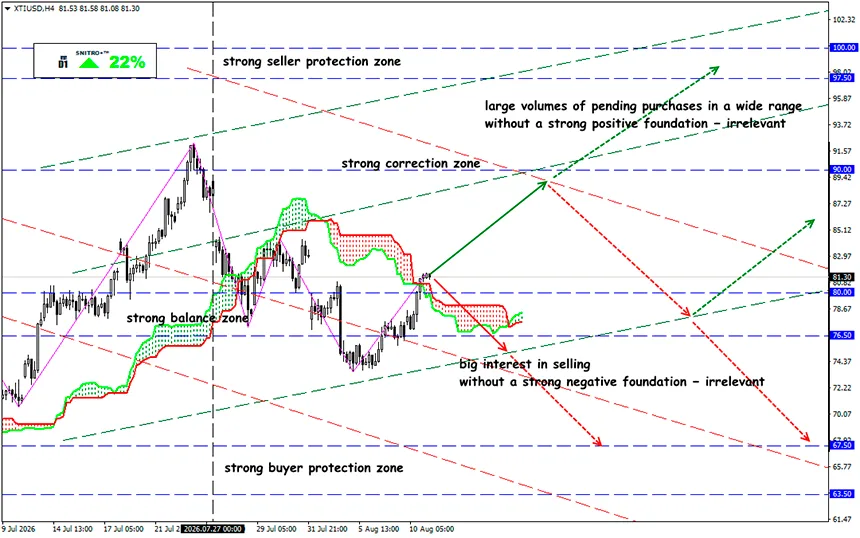
XTI/USD
Key zone: 78.00 - 83.00
Buy: 83.50 (after retesting the 81.50 level); target 85.50–87.50; Stop Loss 82.80
Sell: 76.50 (on strong negative fundamentals); target 73.50; Stop Loss 77.20
WTI is trading above $82 per barrel again: as of August 11, futures are hovering around $82.47, while Brent is near $87.86. The main driver of the rebound is not demand, but the geopolitical risk premium. U.S.-Iranian negotiations over the conditions for restoring full shipping through the Strait of Hormuz are stalling, forcing the market to once again price in the risk of supply disruptions.
At the same time, the fundamental picture remains mixed.
Let’s recap:
U.S. inventories are limiting the upside potential: in the week ending July 31, crude stocks rose by 2.5 million barrels to 407.0 million. That is about 6% below the five-year average. At the same time, gasoline inventories fell by 1.6 million barrels, while distillate inventories declined by 3.5 million. Therefore, the increase in crude inventories cannot be interpreted as an unequivocally bearish signal: the refined products market remains much tighter.
- The increase in commercial crude inventories indicates that domestic U.S. supply is still capable of offsetting part of the external risks. Refineries were operating at around 96.5% utilization, processing approximately 17.2 million barrels per day.
- Crude oil imports rose to 6.2 million barrels per day, although the four-week average remained 4.4% below the level seen a year earlier.
- The gradual recovery in OPEC+ production is also putting additional pressure on the market. In August, seven key members of the alliance increased their target production by another 188,000 barrels per day. In July, OPEC production increased by 1.17 million barrels per day to 19.85 million.
- The actual increase in supply is constrained by shipping geography: the problem is not only how much oil is being produced, but whether that crude can physically reach buyers.
That is why, for WTI, it is currently more important to monitor not only inventory balances but also tanker flows through the Persian Gulf.
Hormuz remains the main source of the market’s risk premium. Even if diplomatic efforts lead to an agreement, physical flows will not immediately return to previous levels.
Washington claims it controls the strait, while Tehran links full reopening of the route to an end to the U.S. blockade, the lifting of sanctions, withdrawal of U.S. forces, the unfreezing of assets, and compensation payments. Iran has already stated that an agreement on individual transit conditions would not automatically mean the full reopening of the strait.
Any new escalation would support prices.
China is ready to return to the market, but this bearish support factor may disappear
- In recent months, lower Chinese imports helped the global market offset disruptions in Middle Eastern supplies.
- In recent months, lower Chinese imports helped the global market offset disruptions in Middle Eastern supplies.
- Average imports for June–July were just 7.78 million barrels per day, compared with an average of 11.99 million during the three months through the end of February.
The reason for this strategy is obvious: China holds enormous inventories, estimated at no less than 1.2 billion barrels, allowing it to temporarily reduce external purchases and rely on accumulated crude.
But that cushion is gradually shrinking. As a result, independent Chinese refiners are likely to return to the market more actively in August, including through purchases of Iranian crude. The physical market balance could tighten noticeably.
So, what does this mean?
The key question for WTI is no longer “how much oil is OPEC+ producing?” but “how much oil can actually reach the global market?”
The current move in WTI looks more like a recovery from a geopolitical discount than the start of a full-fledged new bull cycle. Supporting buyers are the risk of disruptions in Hormuz, declining U.S. refined product inventories, and the potential return of China to active purchasing. Supporting sellers are rising U.S. crude inventories, recovering OPEC+ production, and continued uncertainty surrounding global demand.
The nearest resistance zone for WTI is located in the $81.50–82.00 range. At current levels, this barrier is already being tested. A sustained move above $82 could open the way toward $83.50–84.00. The next major supply zone lies at $85.50–86.50.
Key support is located near $78. As long as the price remains above that level, the recovery scenario retains the advantage. A break below $78, by contrast, would increase the probability of a return toward recent lows and suggest that the geopolitical premium is rapidly being priced out.
So we act wisely and avoid unnecessary risks.
Profits to y’all!


