



How to trade when the market ignores data

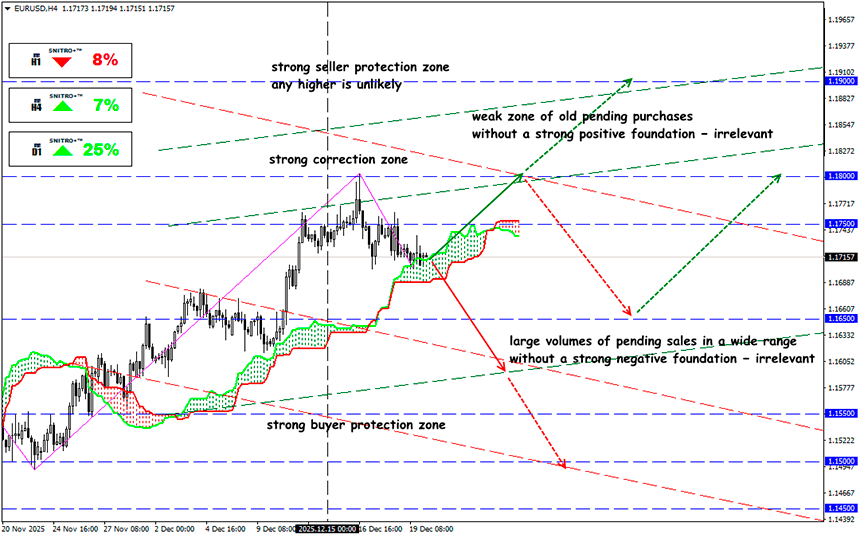
A dangerous year-end range
EUR/USD
Key zone: 1.1700 - 1.1800
Buy: 1.1750 (on strong positive fundamentals) ; target 1.1950-1.2000; StopLoss 1.1680
Sell: 1.1650 (after retesting the 1.1750 level) ; target 1.1500; StopLoss 1.1720
Last week was packed with key reports from the United States, the Eurozone, and the UK. The three largest monetary regulators announced rate decisions, yet markets barely moved.
The most likely explanation for this seemingly illogical flat market is that the data were mixed and contradictory.
And yet:
- key US reports — NFP and CPI inflation — came out in the same direction;
- the Bank of Japan raised rates to a 30-year high, even though Japan had been the main liquidity supplier to US markets throughout those three decades;
- the Federal Reserve and the Bank of Canada launched new QE programs.
Logically, this should have fueled risk appetite and pushed the dollar lower. Instead, market participants are behaving as if a global crisis were about to begin — closing long positions and neutralizing every attempt at growth.
The problem is that the market interpreted the CPI release in favor of the greenback not because it “canceled” future rate cuts, but because the report itself was distorted. Data collection started later than usual due to the prolonged shutdown, and some components were calculated using statistical assumptions and carryovers.
For example, the “fantastic” US inflation report showed CPI returning to March 2021 levels, even though growth had been expected:
- CPI 2.7% YoY, Exp. 3.1%
- Core CPI 2.6%, Exp. 3.0%
However, the details on the BLS website reveal the real issue. October data for many components were missing due to the shutdown, so the BLS effectively filled the gaps to preserve month-to-month comparisons.
In housing (shelter), for instance, October inflation was assumed to be zero (!). Since shelter accounts for roughly 35% of CPI — the single largest component — this assumption alone pushed Core CPI lower.
Meanwhile, November PCE data were once again not published. The Bureau of Economic Analysis postponed the release for the second time — the first delay was also caused by the shutdown.
The reason is political as well. Economists were reportedly asked not to irritate Trump. Had the latest PCE data contradicted the narrative of zero price growth in categories like housing, few would have believed in Trump’s “victory over inflation.”
So the decision was to wait a couple of weeks, let the CPI optimism fade, and then reintroduce negative signals via PCE.
November labor market and inflation reports failed to redraw the fundamental picture. Traders remain almost certain that the Fed will keep rates unchanged at its January meeting.
As a result, the market chose to offset speculative attempts to push major currencies beyond long-term trends by reallocating capital into other assets — gold or crypto. There are no strong fundamental drivers capable of triggering a trend reversal or even a deep correction before year-end. But risks in a thin market should not be underestimated.
So we act wisely and avoid unnecessary risks.
Profits to y’all!


