



Gold and silver: why it's worth buying now
Gold asks investors to believe in the price story
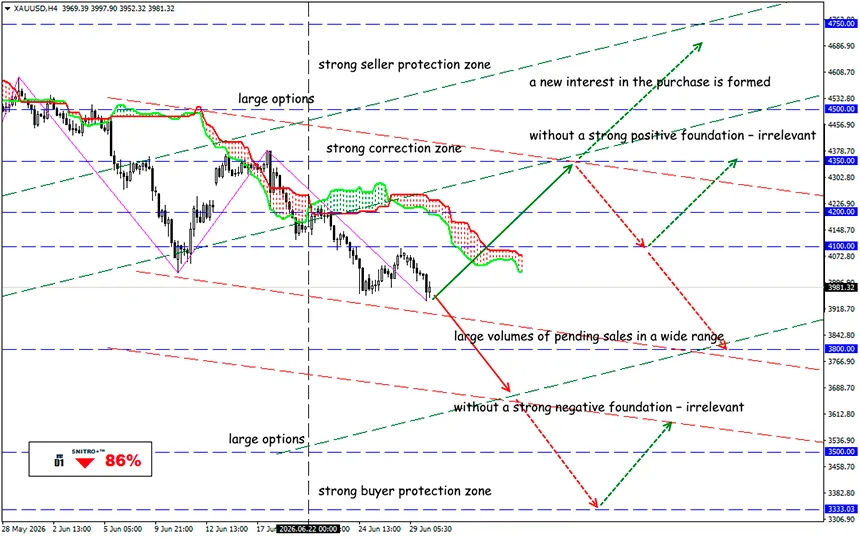
XAU/USD
Key zone: 3,850.00 - 4,000.00
Buy: 4,100.00 (on a confident break above 4,000); target 4,350-4,500; StopLoss 4,000.00
Sell: 3,800.00 (on a pullback after retesting 3,950); target 3,650-3,500; StopLoss 3,900.00
There is a widely held belief that buying precious metals in late June or early July and holding positions until the end of the year consistently generates solid profits. Technically, neither gold nor silver has any objective basis for "seasonality," but there are recurring price movement patterns.
One such pattern suggests that precious metals reach a significant low in June and then rise steadily through Christmas (or at least until Thanksgiving). There have been numerous examples of this behavior.
Silver demonstrates a particularly clear tendency: prices decline and reach a bottom in late June before rallying toward new annual highs by late November or early December. Gold has historically followed a similar pattern, although it tends to trade sideways more often during July, while silver usually experiences a sharp rally during that month.
Last year, gold prices surged from around $3,300 per ounce in June to approximately $4,300 per ounce by year-end. Silver performed even better, roughly doubling in price—from $35 per ounce to around $70 by the end of the year.
This "second-half-of-the-year rally" pattern even extends to copper, which is valued almost as highly as silver as an indispensable industrial metal. As silver prices rise, consumers are likely to substitute cheaper copper wherever possible. Supply and demand dynamics are already signaling higher prices.
Copper demand is projected to be nearly 50% higher by 2040 than current levels, exceeding 40 million metric tons annually. Copper may well become the opportunity overlooked by investors focused exclusively on precious metals.
However, there are even broader reasons to buy gold and silver this year.
- Central banks continue accumulating precious metals.
Monetary authorities worldwide continue increasing their gold and silver reserves—it is unlikely they are doing so while expecting prices to fall. Gold has already overtaken U.S. Treasury securities in attractiveness, while countries are actively repatriating their gold reserves from vaults in London, New York, and other financial centers.
- Market manipulation and precious metals price suppression are coming to an end.
For many years, major bullion banks artificially suppressed gold and silver prices by maintaining massive short positions in the London and New York futures markets. Today, market power has shifted eastward toward Shanghai and Hong Kong, and there are clear signs that these banks are finally abandoning this strategy. For example, JPMorgan, which paid a massive fine just a few years ago for market manipulation, closed a silver short position exceeding three million ounces in 2025.
- The silver supply deficit remains in place.
The supply-demand imbalance is likely to worsen further. AI, robotics, and defense technologies are joining solar panels, electric vehicles, medical devices, mobile phones, and an ever-expanding list of industrial applications requiring silver. This creates poorly controlled annual demand exceeding 2 billion ounces, while global mine production amounts to only about 800 million ounces. In other words, annual mining covers barely 40% of total demand.
- Rising inflation.
More than $1 trillion spent by the United States on the conflict with Iran does nothing to reduce America's national debt. The new Fed Chair has already indicated that inflation is likely to remain a problem in the foreseeable future. Inflation erodes the purchasing power of the U.S. dollar, which, in turn, supports higher prices for real money—gold and silver.
And what is the result?
Current long-term forecasts for 2030 reach as high as $18,000 (or more) per ounce of gold and $1,500 (or more) per ounce of silver. Even conservative projections suggest gold above $5,000 and silver above $100 per ounce by 2027.
Incidentally, Trump reportedly promised longtime economic adviser Judy Shelton that, as part of America's 250th anniversary celebrations, he plans to issue gold-backed U.S. Treasury bonds and revalue America's official gold reserves. If either of these initiatives becomes reality, it could serve as a powerful catalyst for gold and silver prices.
So we act wisely and avoid unnecessary risks.
Profits to y’all!


