



From wall street to seoul: ai boom under threat
Debt is crushing technology stocks
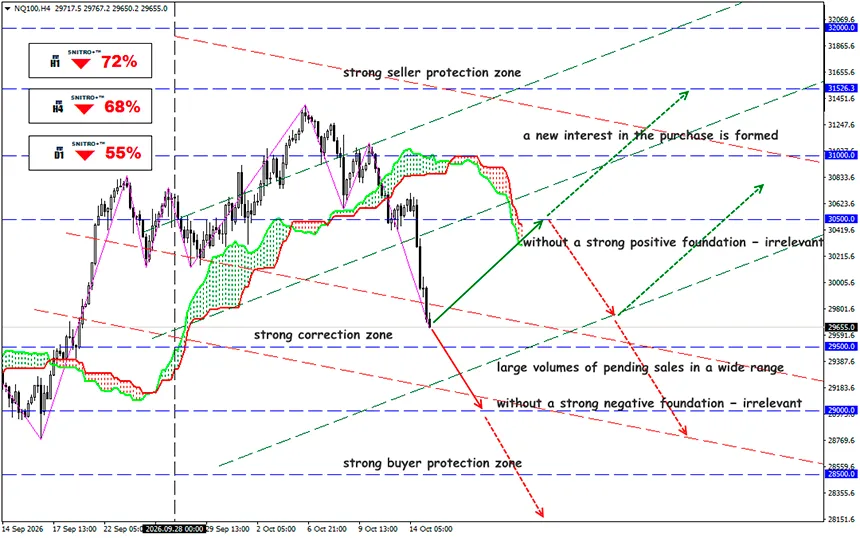
NQ100
Key zone: 29,500 -30,000
Buy: 30,500 (on strong positive fundamentals); target 31,500-32,500; StopLoss 30,000
Sell: 29,000 (on a decisive break above 29,500); target 27,500-26,500; StopLoss 29,500
Inflation and expensive borrowing are forcing investors to reassess AI company valuations. A global sell-off in technology stocks has exposed a problem: massive investments in data centers are becoming increasingly dependent on costly financing.
Unfortunately, record profits at chipmakers are not enough to save the market. Investors are beginning to assess not the prospects of AI itself, but companies' ability to service their debt.
As a reminder:
On October 15, the global technology sector came under pressure following the release of U.S. inflation data. September CPI accelerated to 3.7% year over year, compared with 3.4% in August, reinforcing expectations of further Federal Reserve rate hikes.
On October 14, the Nasdaq Composite lost 1.9%, while the S&P 500 declined 1.1%. During morning trading on October 15, Nasdaq 100 futures fell 1.1% to 29,842.75 points, while S&P 500 futures dropped 0.4% to 7,740.25 points. Asian semiconductor manufacturers were particularly hard hit. South Korea's Kospi fell approximately 7.6%, Japan's Nikkei 225 lost 4.9%, and Taiwan's Taiex declined 3.4%.
The scale of the correction reflects the high concentration of investment in companies providing AI infrastructure. For example, Samsung Electronics shares lost approximately 9.5%, SK Hynix declined 11.1%, and SoftBank fell 9.3%.
The main source of risk is the mismatch between the pace of capital expenditures and the time required to generate returns.
Building data centers requires substantial upfront investment in accelerators, servers, power infrastructure, and cooling systems. Meanwhile, capital recovery takes years, and equipment becomes obsolete quickly.
This creates a dangerous chain reaction: rising interest rates increase borrowing costs, reduce free cash flow, constrain new investment, and lower the fair value of future earnings.
Operators financing construction primarily through debt are particularly vulnerable. Large cloud platforms with stable cash flows have significantly greater financial resilience.
The market is assessing not only current chip demand, but also the sustainability of customers' investment spending in 2027.
An additional risk for memory chip manufacturers is the expansion of supply from Chinese competitors, including CXMT. This increases the likelihood of future pressure on prices and profitability.
Investors are gradually shifting from valuing AI companies based on revenue growth rates toward analyzing free cash flow, debt burdens, and returns on capital expenditures.
The Federal Reserve is adding pressure to the sector: on October 15, the yield on 10-year Treasuries fell to approximately 5.10%, while the two-year yield declined to 4.72%. However, the decline in yields was driven primarily by safe-haven demand rather than a sustained improvement in credit conditions.
Inflation risks persist: expensive oil and rising energy costs for data centers limit the Federal Reserve's room to ease monetary policy.
So What Is the Bottom Line?
A crisis of confidence in AI business financing does not yet mean a crisis in demand for artificial intelligence. However, the structure of the investment boom is becoming vulnerable.
- Stock market: Further compression of technology company valuation multiples and the risk of the correction spreading to broader indices.
- Credit market: Higher borrowing costs for data center operators, particularly those with substantial debt burdens.
- Semiconductors: A potential slowdown in orders if cloud companies revise their capital expenditure budgets.
- Global economy: A reduction in AI investment could weaken demand for equipment, electricity, and industrial infrastructure.
The base-case scenario for the coming weeks is continued elevated volatility and predominantly bearish pressure on the technology sector. The market is demanding evidence that AI companies can generate sufficient cash flow to finance further growth.
The key signal for traders is the movement of credit spreads and bond yields among data center operators. The credit market may reveal earlier than the stock market whether the repricing of AI boom risks has run its course.
So we act wisely and avoid unnecessary risks.
Profits to y’all!


