



Fear changes the rules of the game

During war, the market chooses the dollar
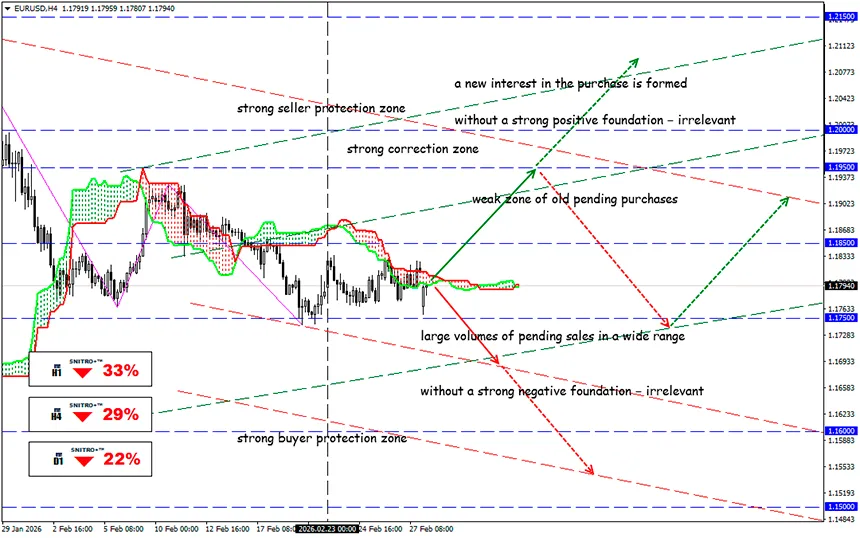
EUR/USD
Key zone: 1.1750 - 1.1850
Buy: 1.1850 (on strong positive fundamentals) ; target 1.2000-1.2050; StopLoss 1.1780
Sell: 1.1720 (on a confident breakout of the 1.1750 level) ; target 1.1600-1.1550; StopLoss 1.1780
The escalation of the conflict around Iran is increasing demand for safe-haven assets — preservation matters more than profit. Investors are reducing risk, and European currencies are losing appeal — capital is flowing into liquid instruments such as the US dollar, US Treasuries, and gold. However, even this hedge may prove risky.
Recall: on Friday, US-Iran negotiations in Geneva ended without results, and the parties announced additional technical consultations that were supposed to take place today in Vienna. But it appears Trump has grown tired of diplomatic battles.
Amid the broad flight from risk, the dollar has once again seen increased demand, reaffirming its safe-haven status. An additional factor is Trump’s tough statements about military support for allies and his claim that resources are “sufficient for several weeks.”
Such rhetoric increases tensions and creates expectations of a prolonged period of instability.
- If (hypothetically) the US sits down for negotiations with Iran tomorrow, buyers of the euro and pound could quickly regain positions.
- If the conflict drags on and expands geographically, the dollar will remain in elevated demand amid further oil market growth and accelerating US inflation.
The second scenario appears more likely.
Trump called on Iranian military forces to lay down their arms in exchange for immunity and openly stated he wants to see new leadership in Iran, even mentioning that he has “three excellent candidates” for future leaders. Iran naturally responded with a categorical refusal, while intensifying retaliatory strikes against Israel and other Middle Eastern countries.
The conflict could evolve into a stable and prolonged confrontation across the Persian Gulf region.
The dollar is also gaining demand due to a developing “inflation spiral,” reacting to rising oil prices. A sharp increase in crude prices will trigger the classic cost-pass-through chain, with the producer price index taking the first hit.
The full transfer of costs into goods and services prices may take three to six months.
Under such conditions, the Federal Reserve will likely maintain a wait-and-see stance not only at upcoming spring meetings but also beyond. A prolonged conflict will gradually reduce the chances of a rate cut at the June meeting, providing additional support to the greenback.
In Europe, the situation looks significantly weaker.
- Industrial activity remains under pressure, while inflation indicators continue to slow. This limits the ECB’s room for hawkish rhetoric and creates additional pressure on the euro.
- Regarding the commodity crisis, the European Commission sent an email to EU governments stating it does not see an immediate impact of the Middle East situation on oil and gas supply security. Judging by current prices, the Commission is either blind or looking in the wrong direction.
- Brent crude prices have already jumped to $79–82 (a 10–13% increase since the market open), and according to several experts (including Barclays and Citibank), this may not be the limit: if the conflict drags on or the Strait of Hormuz is fully blocked, prices could reach $100–120.
- Rising gasoline prices will increase logistics, aviation, and production costs.
From a geopolitical perspective, this could support the dollar at least in the short term while uncertainty persists.
Against this backdrop, the US currency is receiving double support: on one hand, resilient US economic data and the Fed’s cautious stance; on the other, its safe-haven status amid rising global risks.
So we act wisely and avoid unnecessary risks.
Profits to y’all!


