



Europe dreams of a world-class exchange
Euronext and Deutsche Börse test the limits of consolidation
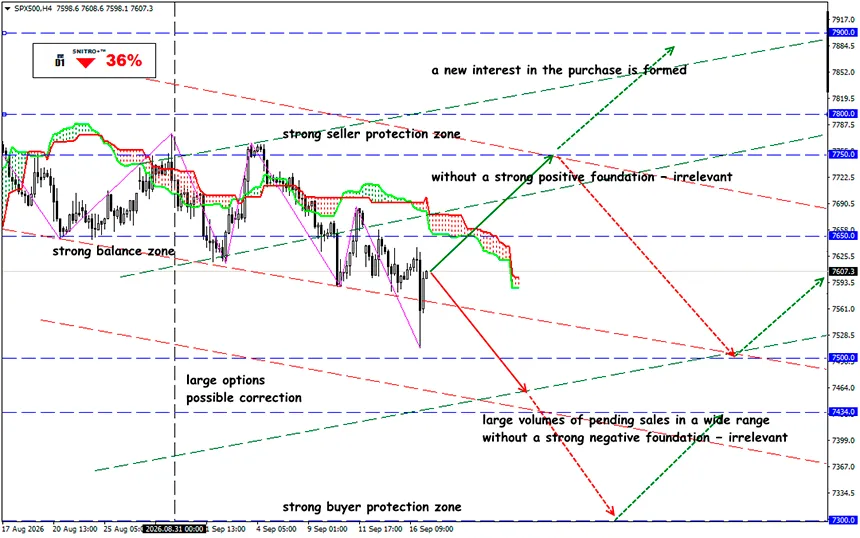
SP500
Key zone: 7,550 - 7,650
Buy: 7,650 (on strong positive fundamentals); target 7,750-7,800; StopLoss 7,580
Sell: 7,500 (on a decisive break above 7,550); target 7,300--7,350; StopLoss 7,570
A merger of Europe’s largest exchanges could help solve the problem of control over capital, but it is unlikely to create a serious competitor to Nasdaq and NYSE. A potential deal would give Europe greater scale and liquidity but would face serious antitrust barriers.
Europe is once again discussing an idea it has been trying to implement for almost two decades: creating a large pan-European market infrastructure capable of keeping capital, IPOs, and liquidity within the region.
The scale of a potential combination would be significant. Euronext operates in eight European countries and includes, among others, the exchanges in Paris, Amsterdam, and Milan. Its market capitalization is estimated at around €16 billion, while Deutsche Börse is worth about €50 billion and controls the Frankfurt Stock Exchange and Eurex — one of the world’s largest derivatives platforms.
A reminder:
- In 2006, Deutsche Börse attempted to merge with Euronext, but the project did not materialize: Euronext ultimately chose to merge with NYSE.
- In 2012, the European Commission blocked the merger of Deutsche Börse and NYSE Euronext due to competition concerns, primarily in the European derivatives market.
- In 2017, the regulator prohibited the merger of Deutsche Börse and London Stock Exchange Group.
Now there is another attempt.
There are no official negotiations yet, but the market is already speculating on the possibility of future consolidation: on September 14, Euronext shares rose by 2.1%, while Deutsche Börse gained 2.9%. Since the beginning of 2026, both stocks have risen by around 26%.
The deeper the market, the more institutional capital it can attract, the higher the liquidity, and the lower the cost of large transactions.
Of course, Europe is losing to the U.S. not because of the number of exchanges, but because of the scale of capital. The problem is that capital remains fragmented among national markets, regulatory regimes, and infrastructures.
In 2024, the capitalization of EU stock markets amounted to around 73% of the region’s GDP. In the U.S., this figure reached 270%. Nasdaq and NYSE concentrate an enormous base of issuers, institutional investors, market makers, and global capital.
Since 2019, the number of companies on the two main U.S. exchanges has grown faster than on the four largest European exchange groups.
This is no longer a question of listing convenience. It is a question of the market’s ability to generate high company valuations. IPOs go where there is market depth. The problem is most acute in the technology sector.
The ECB has highlighted several notable examples: Britain’s Arm chose a direct listing on the U.S. market in 2023, while CRH, Linde, Flutter Entertainment, and other companies abandoned European exchanges or moved their listings to the U.S.
The economic rationale of an Euronext+Deutsche Börse deal lies in scale. Today, a company entering the European public market interacts with a system where national differences in regulation, supervision, and infrastructure remain. For example, the current Euronext does not cover the region’s largest national market — Germany.
A potential combination would connect the German market with Euronext’s infrastructure and provide broader access to investors in France, Italy, the Netherlands, and other countries where the group operates.
The exchange platforms would benefit from greater scale in trading, listings, clearing, settlement, and other infrastructure services.
And What Is the Result?
A deal between Euronext and Deutsche Börse could create world-class infrastructure. But calling it a European competitor to Nasdaq and NYSE is still premature. The U.S. has not only large exchanges but also an enormous concentration of institutional capital, technology companies, liquidity, and global investors.
If a combination of Euronext and Deutsche Börse leads to greater liquidity, more listings, and increased cross-border capital flows, it will become part of a broader restructuring of the European market. As of September 17, 2026, the market has received a signal that such a project may be possible — but not the project itself. The next stage will be determined not by statements, but by the emergence of official negotiations, the deal structure, and the response of European antitrust authorities.
So we act wisely and avoid unnecessary risks.
Profits to y’all!


