



Europe begins a war for survival

The EU is undergoing a stress test
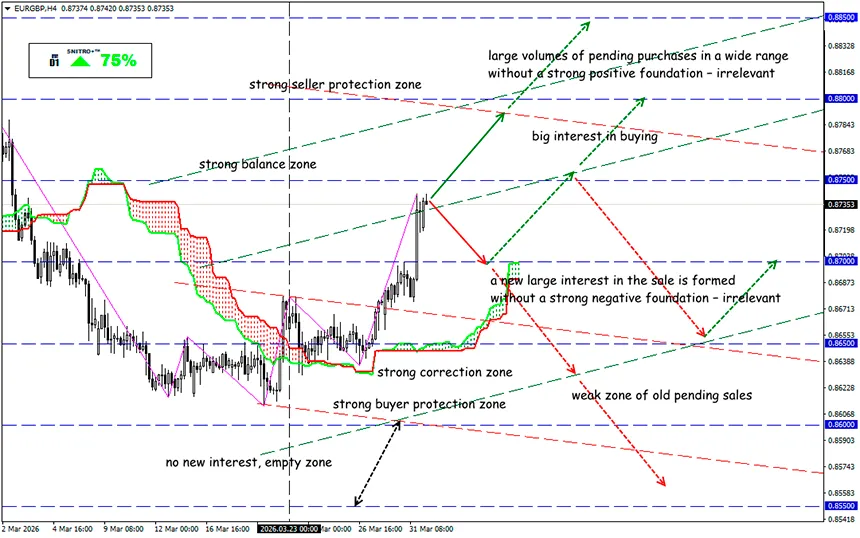
EUR/GBP
Key zone: 0.8700 - 0.8750
Buy: 0.8750 (on a pullback following a retest of 0.8730); target 0.8850-0.8900; StopLoss 0.8700
Sell: 0.8650 (against a strong negative fundamental backdrop); target 0.8450-0.8400; StopLoss 0.8700
Europe is facing a stability test — both political and energy-related — due to low gas reserves. The conflict in the Middle East continues, and the problem with LNG supplies from Qatar remains a key factor of uncertainty for filling storage facilities.
Even if hostilities subside, the war has already dealt a significant blow to gas markets: Iranian attacks have reduced Qatar’s LNG export capacity by approximately 17% for three to five years.
Let us recall:
The latest eurozone CPI report came out in the “red zone.” On the one hand, all components fell short of forecast values. On the other hand, the release reflected an acceleration of overall inflation in the European region. Traders reacted weakly to this publication, since geopolitics is currently setting the tone of trading.
The March increase in inflation in the eurozone is external — “energy-related” — rather than internal, “demand-driven.” The eurozone is structurally dependent on energy imports (especially oil and gas), therefore such a result was predictable.
The European Commission has no illusions about a quick return of the markets to normal. Moreover, despite the supply shortage, Asian buyers willing to pay astronomical premiums still managed to intercept part of the LNG supplies originally intended for Europe.
This was immediately reflected in European statistics. The growth of LNG imports into Western Europe in March slowed sharply, amounting to only 3.5% year-on-year. For the EU, this trend is extremely dangerous.
The EU is preparing for a prolonged energy crisis: Brussels is considering the possibility of activating emergency mechanisms.
- Among the European Commission’s top-priority plans are already proposals to limit grid tariffs and reduce taxes on electricity. More stringent measures are not ruled out.
- The energy factor will remain the main risk for the ECB’s forecasts in the coming quarters. The situation allows the ECB to maintain a neutral position and not rush to raise the interest rate as early as April. This time buffer will allow the regulator to assess secondary effects: whether the energy shock will spread to wages, the services sector, and inflation expectations.
The UK is trying to join the fight, but so far without success.
- Prime Minister Starmer tried to draw attention to how his government is helping Britons cope with the rising cost of living, despite growing pressure to announce additional support in connection with the economic consequences of the Iranian crisis.
- His statement also highlighted previously announced measures coming into force on April 1, including an increase in the minimum wage, a freeze on medicine prices, and a reduction in electricity bills until July of this year.
- Starmer tried to create the impression that concrete actions are being taken to mitigate the economic consequences of the war with Iran, for example by organizing round tables with business leaders and holding emergency meetings with his ministers and Bank of England Governor Andrew Bailey. However, expectations of more substantial government support in connection with rising prices were not met.
- Investors, faced with uncertainty and the limited scope of the proposed assistance, preferred to move into safer assets.
At the moment, this has had a very negative impact on the pound, which has fallen sharply against the U.S. dollar. The EUR/GBP cross rate was also forced to react. At the moment, a technical correction is needed, but there is still no strong signal for a reversal of the bullish trend.
So we act wisely and avoid unnecessary risks.
Profits to y’all!


