



Europe at risk: TTF could rise above €100
Gas could become too expensive for Europe
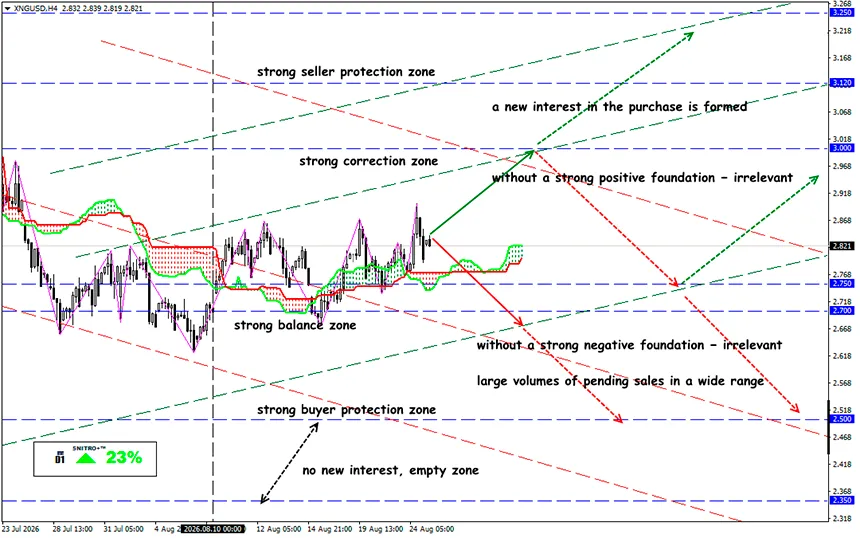
XNG/USD
Key zone: 2.750 - 2.950
Buy: 3.025 (on a decisive break above 3,000); target 3.250; StopLoss 2.950
Sell: 2.700 (on strong negative fundamentals); target 2.500; StopLoss 2.750
Europe is heading into winter with a gas shortfall. Low inventories, competition with Asia for LNG, and disruptions in the Middle East are turning the rebuilding of European reserves into an expensive challenge. As of August 25, EU storage facilities are about 62–63% full, compared with around 74% a year ago, while the five-year seasonal average is close to 80%.
By itself, this level does not yet indicate a threat of a physical shortage: the European Commission currently sees no immediate risks to security of supply. The problem lies elsewhere — Europe has little time left to make up the shortfall, while the cost of additional gas volumes is rising.
A reminder:
If disruptions to energy supplies from the Middle East persist, European prices may need to rise significantly higher to attract sufficient LNG volumes and rebuild inventories before winter. In a stress scenario, the bank sees December TTF rising above €100/MWh, compared with a baseline forecast of around €50/MWh.
The current situation can be described as a vicious cycle:
low inventories → need to accelerate injections → rising LNG demand → competition with Asia → higher TTF → expensive injections → weaker economic incentive to buy gas → inventories remain low.
This mechanism now represents the greatest threat to the market.
Inventories Are Behind Schedule
The reason is a combination of several factors. Europe ended the previous heating season with low inventories, while the subsequent replenishment has not been fast enough. High prices also reduce the economic attractiveness of summer injections: operators have to buy expensive gas today, betting that they will be able to sell it at an even higher price in winter.
Europe Is Losing the Competition for LNG
Liquefied natural gas remains the key source of additional supply. But this is precisely where the main risk emerges.
Europe is competing with Asian buyers for flexible LNG cargoes. Disruptions to shipments through the Strait of Hormuz have reduced the availability of Middle Eastern LNG, intensifying competition for alternative volumes. At the same time, U.S. LNG exports rose 23% year over year in January–July 2026, but Europe and Asia together absorb more than 80% of U.S. supplies.
This means that even record U.S. exports do not guarantee Europe sufficient gas volumes. If Asian buyers are willing to pay more, some flexible cargoes will be redirected there.
Weather as a Source of Uncertainty
If winter turns out to be significantly warmer than normal, gas consumption for heating will be lower, making the current inventory shortfall less critical. This is why weather can fundamentally change the market balance even without a sharp increase in supply.
However, relying exclusively on a mild winter is risky. In cold weather, low initial storage levels mean faster withdrawals and increase the likelihood that Europe will have to actively purchase LNG when winter demand is already high.
So, what does this mean?
There are three factors that could shift the situation in Europe’s favor: a recovery in Middle Eastern supplies, weaker Asian competition for LNG, and a warmer winter.
The European gas market is currently facing not an immediate physical shortage, but a shortage of safety margin and future security of supply. In such a situation, €100/MWh no longer looks like a purely theoretical level and becomes a plausible stress-scenario target.
If Europe can quickly rebuild inventories and secure more LNG, the current price spike will prove temporary. But if Middle Eastern disruptions persist, Asia continues competing for LNG, and injections remain slow, the need to rebuild winter inventories itself could trigger another sharp surge in gas prices.
So we act wisely and avoid unnecessary risks.
Profits to y’all!


