



Euro: a new victim or escalation
What Trump wants from the European currency
EUR/USD
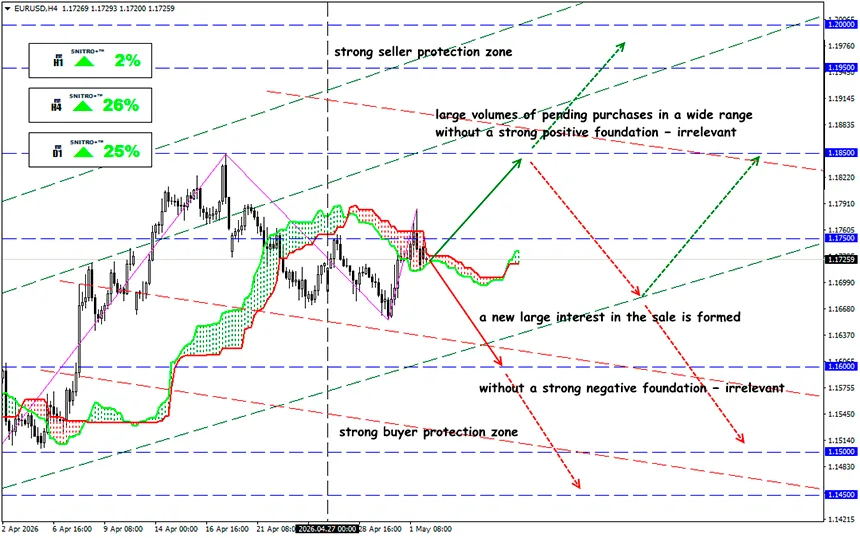
Key zone: 1.1680 - 1.1750
Buy: 1.1800 (on a decisive break of the 1.1750 level) ; target 1.2000-1.2150; StopLoss 1.1740
Sell: 1.1650 (on strong negative fundamentals) ; target 1.1500; StopLoss 1.1720
Trump intends to raise tariffs on cars and trucks from the European Union to 25% (previously agreed at 15%). The U.S. president cites the EU’s failure to comply with the terms of the tariff trade “deal” as the reason for this move.
These tariffs were part of a broader agreement under which the EU accepted a near-universal U.S. tariff rate of 15% and agreed to eliminate most of its own tariffs on American goods. The deal was unpopular in Europe, but EU leaders argued it would protect companies from further tariff increases.
Now Donny has told journalists that higher tariffs will force European automakers to relocate production to the United States more quickly.
Pressure on the euro comes from rising risk-off sentiment amid the diplomatic deadlock between the U.S. and Iran, as well as a new round of tariff confrontation between the U.S. and the EU. If Donny maintains a hardline stance, further developments will follow an escalation scenario. Although he may once again “play TACO,” as has happened before.
Recall: last year, the EU prepared a $95 billion list for retaliatory tariffs in case the U.S. follows through on its threats against the European auto industry.
- According to Trump, the European Union is not complying with the trade agreement reached last year (the so-called “Turnberry deal”). In particular, Donny accused Brussels of delaying the ratification process, which in his view renders the agreement ineffective.
- High tariffs are also intended to force European automakers to localize production in the U.S.
- The U.S. domestic market will also feel the negative impact of the new tariffs: the higher rate will cost American consumers about $15 billion per year in markups on cars and spare parts. After Trump’s statement, shares of Ford Motor and General Motors fell by 2.4% on the New York Stock Exchange, while Stellantis shares dropped by 3.3%.
- European countries and companies with a high share of exports to the U.S. and integrated supply chains (Germany, Slovakia, Italy, Sweden) will suffer the most. For example, according to the Kiel Institute for the World Economy, Germany’s short-term losses will amount to about €15 billion, potentially reaching €30 billion in the long term.
- Given that Germany is the key locomotive of the European economy, the consequences of trade escalation will inevitably be felt across the entire eurozone.
- Exports of German cars to the U.S. have already fallen by nearly 10% due to previous increases, so another “tariff strike” could make shipments of many models simply unprofitable.
At the moment, the official decree on tariff increases has not yet been signed, but Trump has publicly promised to do so — and will if the EU does not begin active discussions on the issue.
Buyers continue to keep the EUR/USD rate within an uptrend, helped by the general weakening of the U.S. dollar in the market.
Over the previous four weeks, the pair traded in a wide range but closed each week in the 1.17 area. However, by the end of the current week, the situation may shift in favor of sellers.
So we act wisely and avoid unnecessary risks.
Profits to y’all!


