



ECB, the Fed, and the Market: who will set the next trend?
Why the ECB Forum matters more than any political argument
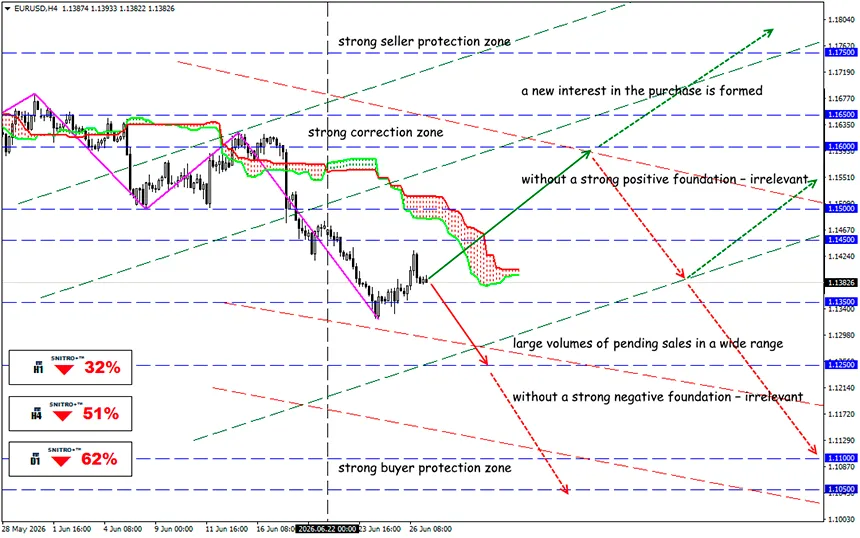
EUR/USD
Key zone: 1.1350 - 1.1400
Buy: 1.1450 (on strong positive fundamentals) ; target 1.1650-1.1700; StopLoss 1.1380
Sell: 1.1300 (on a pullback following a retest of 1.1400) ; target 1.1150-1.1050; StopLoss 1.1370
The world's four largest monetary authorities hold a closed exchange of views, but they come together on one stage to present their conclusions. The annual ECB Forum on Central Banking is the most important information event of the European summer, as it is here that market participants can adjust their expectations regarding the ECB's future policy.
On July 1 at 13:00 GMT, global financial markets will focus on the Portuguese city of Sintra, where ECB President Christine Lagarde, Federal Reserve Chair Kevin Warsh, Bank of England Governor Andrew Bailey, and Bank of Canada Governor Tiff Macklem will appear together during the forum. Comments from lower-ranking monetary officials will provide additional background information.
Formally, this is only a panel discussion. However, for professional market participants, such events have traditionally become one of the main sources of signals about the future direction of global monetary policy.
The official theme of the forum is "Shaping Europe's Future: Innovation, Growth and Stability." Markets, however, will be looking for entirely different answers: where the line lies between fighting inflation and supporting economic growth, how likely further monetary tightening is, and whether the world's leading central banks are prepared to coordinate their actions amid ongoing geopolitical instability.
The uniqueness of this year's forum lies in the fact that it takes place only weeks after the June policy decisions of the world's largest central banks.
- A significant portion of positive expectations for the euro has already been priced in. If Christine Lagarde reaffirms her commitment to a tough anti-inflation stance or suggests that interest rates may need to remain high for longer, European bond yields could begin rising again, providing additional support for the single currency. The euro could continue strengthening, particularly if the Fed Chair's remarks prove less hawkish.
- The opposite scenario: if ECB officials emphasize the slowdown in the eurozone economy, growing external risks, or the need for caution regarding future rate decisions, the market will quickly reassess the probability of further monetary tightening. In this case, long euro positions would be the most vulnerable, since a considerable share of speculative capital is already positioned for further appreciation of the European currency.
- If Fed Chair Kevin Warsh confirms his commitment to the "low-information approach," volatility in the foreign exchange market could increase significantly, as investors would be forced to rely even more heavily on macroeconomic data alone. Any unexpected comments from the Fed could alter the yield differential between U.S. and European bonds, traditionally the primary driver of the EUR/USD exchange rate.
European equity markets will also remain highly sensitive to the forum's outcome. For the banking sector, a more hawkish ECB tone could become a positive factor thanks to the preservation of high net interest margins. At the same time, technology companies, real estate developers, and corporations may face additional pressure due to rising capital costs. Elevated volatility is also expected in the government bond markets of Germany, France, and Italy, where even small changes in interest rate expectations can trigger noticeable movements in bond yields.
And what is the result?
Experience from previous ECB forums shows that markets react most strongly not to prepared speeches but to central bank governors' answers during the open discussion. It is precisely these spontaneous comments that allow investors to assess policymakers' true views and adjust expectations regarding future monetary policy.
We should closely monitor not only Lagarde's remarks but also any divergence between the ECB's and the Fed's positions. If the European regulator maintains a more hawkish tone than its American counterpart, the euro could receive fresh upward momentum. However, if the Fed once again proves to be the more hawkish institution, the European currency may face profit-taking, while pressure could spread across most European financial assets.
So we act wisely and avoid unnecessary risks.
Profits to y’all!


