



East-West rendezvous: rates above trade
What to expect from Trump’s visit
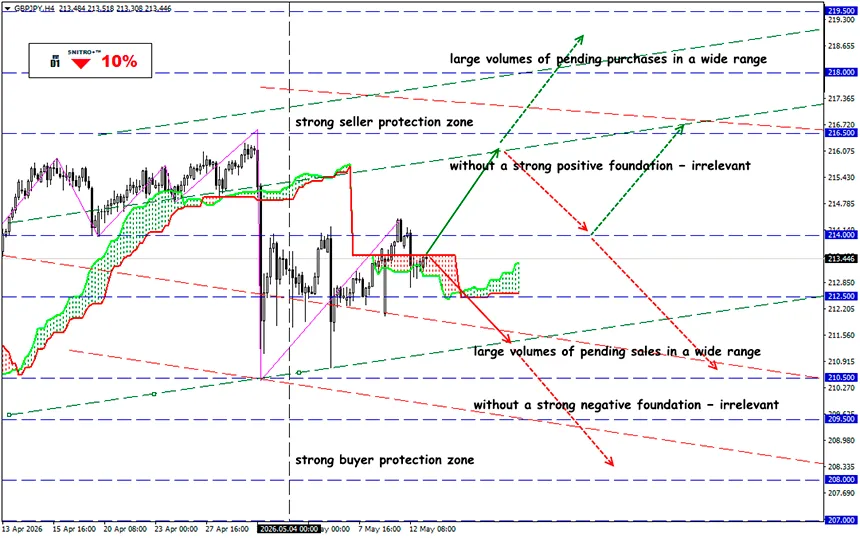
GBP/JPY
Key zone: 212.50- 214.00
Buy: 214.50 (on strong positive fundamentals); target 216.50-218.00; StopLoss 213.80
Sell: 213.50 (on a confident break of 214.00) ; target 211.50; StopLoss 214.20
This is the first visit by a U.S. president to China in almost nine years and a critically important stress test for the global economy. According to media reports and think tanks, the key agenda includes trade, tariffs, rare earth metals, high technology/AI, Taiwan, and the conflict surrounding Iran.
Why the U.S. Needs This
- Trump does not need “friendship with China,” but rather managed stabilization. He needs a result that can be sold to a domestic audience as an economic victory: an extension of the trade truce, Chinese purchases of U.S. agricultural products and aircraft, access for American business, and a reduction in the risk of a tariff war.
- Technological objective: the U.S. wants to preserve leadership in AI, semiconductors, and standards, while at the same time avoiding a complete breakdown of supply chains. The delegation, involving major technology and corporate figures, demonstrates that the visit is not only diplomatic but also corporate-industrial in nature.
- Geopolitical objective: prevent Iran, Taiwan, and sanctions disputes from disrupting economic stabilization. Nevertheless, before the trip Trump did not lower the level of aggressive rhetoric toward Iran, although disagreements in this area remain critical.
China’s Goals
- The main objective is to secure its status as an equal center of power. China seeks predictability regarding tariffs, export restrictions, and access to technology, but without concessions that would appear to be capitulation. However, expectations of a “big deal” are limited: temporary stabilization and the creation of conflict-management channels are more realistic.
- Technological objective: leverage its influence in rare earth metals and supply chains. Even after the pause in restrictions, the U.S. remains vulnerable because of its dependence on Chinese rare earth supply chains.
- Geopolitical objective: obtain at least minimal assurances from Trump that the U.S. will not accelerate political support for Taiwan’s independence. Taiwan, rather than the trade deficit, remains the summit’s potential “black swan.”
Impact on Europe
This visit could reshape capital flows, euro dynamics, Germany’s export outlook, and the risk assessment of European assets, as Europe is particularly sensitive to supply-chain logistics disruptions.
If worsening negotiations intensify concerns around Iran and the Strait of Hormuz, Europe will suffer more than the United States.
A positive summit outcome could reduce fears of a new wave of U.S. tariffs against Europe. If both sides announce an extension of the tariff truce, limited de-escalation on technology, and preservation of trade channels, the market will shift into a global risk-selling mode.
This means:
- reduced demand for the U.S. dollar as a safe-haven asset;
- growing interest in cyclical currencies;
- recovery of carry trades;
- capital inflows into European equities;
- rising expectations for a recovery in European exports.
In this scenario, EUR/USD could receive strong support even without active ECB measures. Short-term opportunities may emerge to buy EUR/USD and EUR/JPY and sell USD/CHF.
Impact on Asian Assets
For Asia, this visit is more important than for Europe: the region is directly tied to China, rare earth metals, logistics, and dollar liquidity. The most sensitive assets are the yuan, Hong Kong tech stocks, Taiwan, Korea, and semiconductors. The most resilient are India and, to some extent, Japan, though only in relative terms.
Chinese and Hong Kong equities will be the first to show a reaction to the outcome of the visit.
Ahead of the meeting, China allowed the yuan to strengthen to a three-year high: the PBoC set the fixing at 6.8467 CNY per dollar, while the offshore yuan broke through 6.8 for the first time since February 2023. This appears to be a signal from Beijing: China wants to demonstrate control, confidence, and readiness for de-escalation.
A positive outcome of the visit: the yuan strengthens, USD/CNH moves lower, and demand rises for Chinese equities and Asian currencies.
A negative outcome: the yuan quickly reverses, USD/CNH rises, and the market begins pricing in the risk of a new tariff war.
Impact on Commodity Markets
Unlike currencies or individual indexes, commodities react not only to headlines but also to expectations. Therefore, the market will assess not only final statements but also the likelihood of a new trade war, a global crisis, and supply shortages.
For example, China is the main driver of oil demand growth, so any positive news for the Chinese economy implies a bullish market for Brent, WTI, and LNG. If both sides avoid harsh confrontation over Iran, part of the geopolitical premium may disappear from prices.
Gold — the main hedge against failed negotiations, technological war, and dollar instability — could surge sharply if:
- tough rhetoric on Taiwan emerges;
- China hints at restrictions on rare earth metals;
- the U.S. intensifies sanctions rhetoric.
Following the summit, central banks may accelerate reserve diversification.
The most likely beneficiaries in a positive scenario: Chinese equities, semiconductors (excluding sanctioned companies), copper, oil, and agricultural commodities.
The most likely global outcome is an extension of the trade truce, a framework dialogue on tariffs, agricultural purchases, and possibly a separate mechanism for investment or trade disputes. This will not resolve systemic rivalry but will reduce the short-term risk premium.
Market reaction is expected to be moderately positive for Chinese equities, Asian currencies, industrial metals, and the U.S. agricultural sector, while neutral or slightly negative for gold.
The optimal outcome for markets is a managed truce. The worst-case scenario is a return to the negative combination of “tariffs + Taiwan + rare earth metals.” For traders, this is not a political show, but a high-volatility event where entry discipline, position sizing, and readiness to change scenarios quickly matter most.
If the summit ends without a communiqué and includes harsh statements regarding Taiwan, Iran, sanctions, or rare earth metals, the market will quickly shift into risk-reduction mode.
Base tactic: do not buy “rumors” before the final communiqué. A StopLoss is mandatory: political headlines can reverse the market within minutes.
So we act wisely and avoid unnecessary risks.
Profits to y’all!


