



Dangerous oil: who does not benefit from high prices
Not everyone profits during war
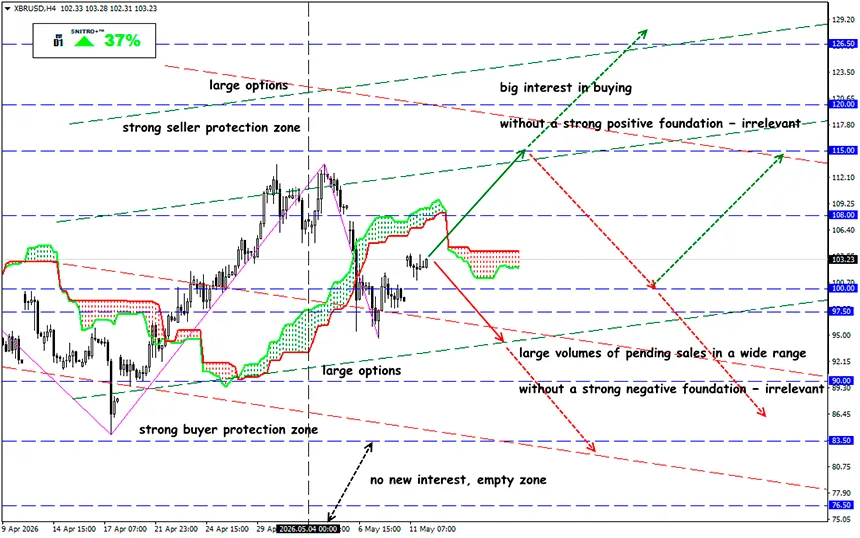
XBR/USD
Key zone: 100.00 - 103.50
Buy: 105.00 (on a decisive break of 104.50); target 107.50-108.50; StopLoss 104.30
Sell: 97.50 (on strong negative fundamentals); target 93.50; StopLoss 98.20
Back in January, most analysts expected Brent crude to trade at no more than $60 per barrel in 2026. At the moment, the price is confidently trading above $100, and many believe that the “third” war in the Persian Gulf should bring substantial profits to all major oil companies.
Unfortunately, this is not the case. For example, Exxon and Chevron posted significant losses, while their European competitors managed to generate profits.
Reminder:
The market closed the first quarter with Brent at $118, while petroleum products rose even more sharply in price. A significant share of Middle Eastern oil became blocked in the Strait of Hormuz area, so exports from America, Africa, and Brazil indeed increased. Western oil companies were expected both to sell larger volumes and receive higher margins per barrel.
Nevertheless, not everyone managed to capitalize on the situation.
- Over three months of military conflict, shares of British giant Shell rose by only 4%, while shares of its European competitors — TotalEnergies, BP, and Eni — increased by 14–17%.
- U.S. companies Chevron and Exxon reported net profits of $2.2 billion and $4.2 billion respectively, down 37% and 46% year-on-year. Their shares declined by 1% and 2%, respectively.
- The impact of war on Western oil giants depends on three factors: hedging positions, trading profits, and the location of production assets.
However, the results of European companies must take into account the effect of the “accounting illusion of losses.”
Oil and gas sales agreements are signed in advance — weeks or months before delivery. To insure against price fluctuations, companies buy contracts that provide payouts if oil prices fall. If prices rise, however, the value of hedges declines, leading to “paper” losses.
This quarter, those losses amounted to $2.9 billion for Chevron and $3.9 billion for Exxon. These losses will be offset by higher revenues once sales are completed.
In addition, there is a special source of profit that U.S. companies have not yet mastered. European companies do not rely solely on their own commodity production — they have built massive trading divisions. These proprietary traders do not simply hedge cargoes; they buy and sell crude oil, petroleum products, and gas, benefiting from pricing imbalances — geographical and time arbitrage.
For example, BP trades approximately 12 million barrels per day, nearly 11 times greater than its own production volumes.
American companies are trying to catch up with competitors. Chevron is actively developing its own trading infrastructure and increasingly sells oil through internal divisions instead of intermediaries. By next quarter, the company expects to independently market more than 40% of its own production — twice as much as a year ago. This will make it possible to support refinery utilization in Asia more effectively, where fuel shortages persist.
And what is the result?
The paradox of the current commodity crisis is that European companies currently appear better adapted to energy shocks, while American oil giants are facing the consequences of their own business structure and heavy dependence on domestic political decisions.
The longer the war in the Persian Gulf continues, the greater the income gap between oil giants will become. Especially if Trump bans fuel exports — something entirely possible if gasoline prices in America reach $5 per gallon. Such a step would widen the WTI discount to Brent and hit the financial position of local producers, limiting profits in both production and refining.
Against this backdrop, the American oil sector is watching the White House’s actions ever more closely: Washington’s future decisions may prove no less important for the industry than the actual price of oil.
So we act wisely and avoid unnecessary risks.
Profits to y’all!


