



Currency intervention as a tool of pressure
Why the U.S. is supporting the Japanese Yen
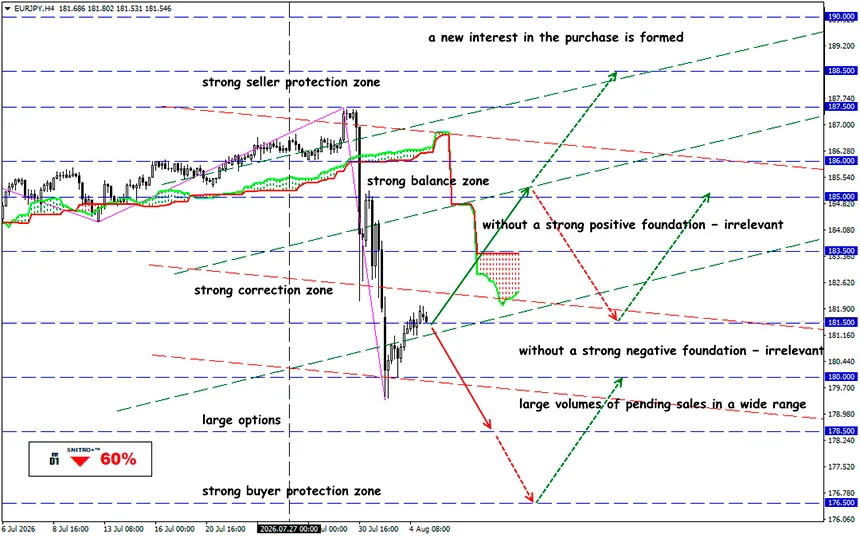
EUR/JPY
Key zone: 180.50 - 182.00
Buy: 182.50 (on strong positive fundamentals); target 183.50-185.00; StopLoss 181.90
Sell: 180.00 (on a pullback following a retest of 181.50) ; target 178.50-176.50; StopLoss 180.60
For the first time since 2011, Japan and the United States have carried out a coordinated currency intervention aimed at supporting the yen. Within just four days, the Japanese currency appreciated by more than 4.5%. The yen's weakness has become an increasingly serious concern for both Japanese and American policymakers due to its impact on import prices and the rising cost of living for households.
Let's recap.
Japan's foreign exchange reserves are primarily invested in U.S. Treasury securities. To conduct a currency intervention, Japan must sell U.S. assets and use the proceeds in dollars to buy yen. The dollars used to purchase yen typically come from Japan's foreign exchange reserves in the form of cash or U.S. Treasury securities.
- The yen has weakened because of higher energy import costs resulting from the conflict in the Middle East and President Trump's tariffs. However, the main driver is the interest rate differential between Japan (1%) and the United States (3.5–3.75%). Investors borrow at low rates in Japan and invest where yields are higher. As a result, capital continues to flow out of Japan, putting persistent downward pressure on the yen while fueling domestic inflation.
- The situation is further complicated by concerns over Japan's fiscal outlook. The country's public debt exceeds 200% of GDP. Rather than being repaid, it is continually refinanced through government bond issuance, with interest costs accumulating over time. Persistent budget deficits have raised concerns that the Japanese government is spending beyond its means.
- President Trump has repeatedly criticized the weak yen, arguing that it gives Japanese manufacturers an unfair competitive advantage. Last March, he adopted a more aggressive stance by proposing tariffs on Japanese imports.
Under these conditions, currency intervention addresses two problems simultaneously. The Bank of Japan sells U.S. dollars and purchases yen, strengthening the Japanese currency. At the same time, the yen received in exchange remains on the Bank of Japan's balance sheet rather than circulating through the economy. This reduces the money supply and helps ease inflationary pressure.
This strategy remains effective only as long as foreign exchange reserves are available. Japan still holds approximately $1.1 trillion in reserves, but they are being depleted rapidly. At the end of April, Japanese authorities spent nearly $74 billion supporting the currency, yet the effect lasted only one quarter. By July 23, the yen had weakened even further, reaching its lowest level against the U.S. dollar since 1986.
According to preliminary estimates, Japanese authorities spent another $84 billion at the end of last week. At that pace, reserves could be substantially depleted within just a few years.
If Japan—the world's largest holder of U.S. government debt—begins selling Treasuries aggressively, Washington could be forced to adopt highly unpopular measures, including spending cuts and tax increases. Responsibility for these "sanctions" would ultimately fall on the U.S. Treasury, as Treasury Secretary Scott Bessent was the one who supported Japan's intervention.
However, the U.S. Treasury's capabilities are far more limited than those of the Federal Reserve. The Treasury does not possess large foreign exchange reserves and cannot simply create a dedicated intervention fund. In practice, U.S. support for Japan has effectively been financed by American taxpayers.
So, what does this mean?
The coordinated currency intervention has not eliminated the underlying causes of the yen's weakness. It has merely delayed the consequences. For traders, this means continued high volatility across Asian financial markets. The primary focus remains on Federal Reserve and Bank of Japan policy, U.S. Treasury yields, and the possibility of further currency interventions.
Japan is likely to continue drawing down its reserves while attempting to support the yen and waiting for the United States to begin cutting interest rates. Meanwhile, U.S. Treasury securities are likely to remain under persistent pressure.
Unfortunately, President Trump's current policies are contributing to elevated inflation. Within the Federal Reserve, discussions have increasingly shifted toward the possibility of another rate hike rather than rate cuts. Consequently, the Bank of Japan may also have little choice but to raise interest rates, possibly as early as September. Pressure across Asian financial markets is therefore likely to intensify. Japan may be able to rely on its reserves for several more years, but if that time proves insufficient to resolve its structural challenges, the world could face another global financial crisis.
So we act wisely and avoid unnecessary risks.
Profits to y’all!


