



Crypto business chooses AI
Why private miners are leaving the process
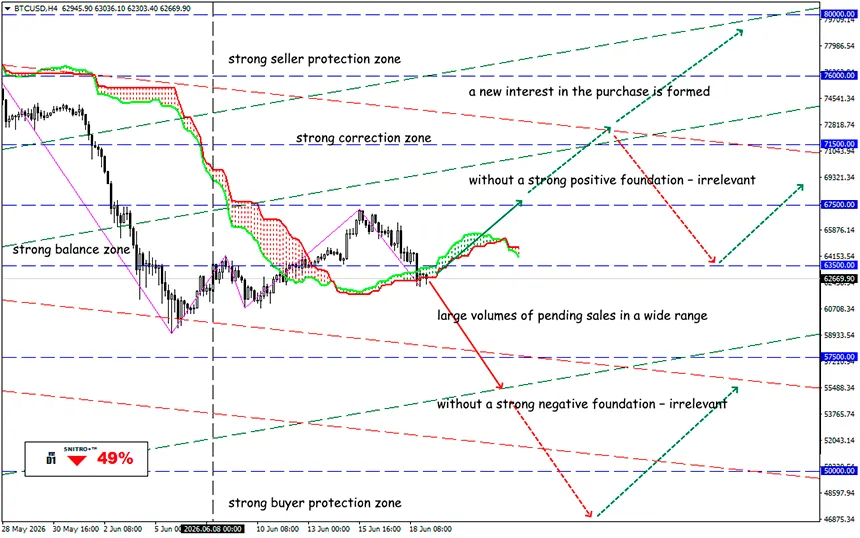
BTC/USD
Key zone: 62,000 - 66,000
Buy: 67,500 (on a confident break above 66,500) ; target 70,000-73,500; StopLoss 66,500
Sell: 61,500 (on strong negative fundamentals) ; target 58,500; StopLoss 62,500
Today’s market constantly demands production and computing capacity to support AI data centers. It is only logical that small and medium-sized companies that previously earned money solely from mining are now redirecting their infrastructure toward a more profitable business model.
The premium for access to equipment and energy is reaching new highs. This means that the number of bitcoins being mined is likely to decline in the near future, and a supply shortage always creates demand, which could have a positive impact on cryptocurrency prices.
Let us recall:
At the moment, the main constraint on AI evolution is not a shortage of chips but a shortage of electricity. Following the 2024 halving, rising network difficulty, and increasing operating costs, Bitcoin mining has become a less predictable business model for public mining companies. As a result, they are increasingly using their facilities, power access, and engineering infrastructure for AI and high-performance computing.
Nevertheless, while major miners are pivoting toward AI technologies, governments are taking the opposite approach.
- For businesses, Bitcoin mining appears to be a weakly predictable model amid rising costs.
- At the state level, mining remains a tool of energy policy, industrial development, and participation in the digital economy. Mining is being used as a serious state resource.
One of the most striking examples of government interest in mining is Oman. Enegix Global announced that it had been selected to support Omanhash.om, which is positioned as the official and mandatory mining pool for licensed mining companies in the country. The project will be developed together with Oman-based Frontier Technologies, which operates in the blockchain and Web3 sectors.
Such a model gives the authorities greater control over local hash rate and the activities of operators.
And Oman is not the only country attempting to integrate mining into its economic policy. For example, Uzbekistan is creating a special zone called Besqala Mining Valley, where residents will be able to mine crypto assets using renewable energy and will be exempt from taxes and fees until January 1, 2035.
As a rule, the crypto assets obtained may be sold or exchanged on both domestic and foreign platforms, but the proceeds and exchange process remain under state control.
In the United States, interest in mining manifests itself through industrial policy. The primary concern is not the mining process itself, but control over the supply chain. According to official data, approximately 97% of ASIC devices are produced by the Chinese companies Bitmain and MicroBT. At the same time, the United States accounts for 37.5% of the global Bitcoin hash rate.
The most relevant example is the Mined in America Act, a bill aimed at developing domestic production of Bitcoin mining equipment. The legislation is also linked to the concept of a strategic Bitcoin reserve and the creation of a closed cycle: from equipment manufacturing to mining and BTC accumulation.
The proposal includes voluntary certification for miners and mining pools, while participants in the program would gradually phase out devices manufactured by companies associated with “foreign adversaries.” This approach allows reserves to be built through domestic energy infrastructure rather than by purchasing BTC directly on the market.
And what is the result?
Mining is developing according to two different scenarios.
- For private companies, it is increasingly becoming just one of several monetization models, alongside AI and data centers.
- For governments, it is a way to utilize energy resources, develop local industry, control hash rate, and gain access to BTC without making direct market purchases.
Therefore, in the coming years, competition in the sector will not be limited to cheap electricity. The key factors will be regulation, equipment manufacturing, access to infrastructure, and control over hash-rate flows.
At the moment, BTC and ETH are attempting to correct, but demand remains weak, making an upward trend difficult to envision. There are currently no technical signs of the downtrend ending for either Ethereum or Bitcoin. The most pessimistic forecast suggests that the market bottom could form in the $40,000–55,000 range. However, we still hope that the market will reverse at least for a short-term correction.
So we act wisely and avoid unnecessary risks.
Profits to y’all!


