



Coercion into peace or the Maduro syndrome

What war means for the oil market
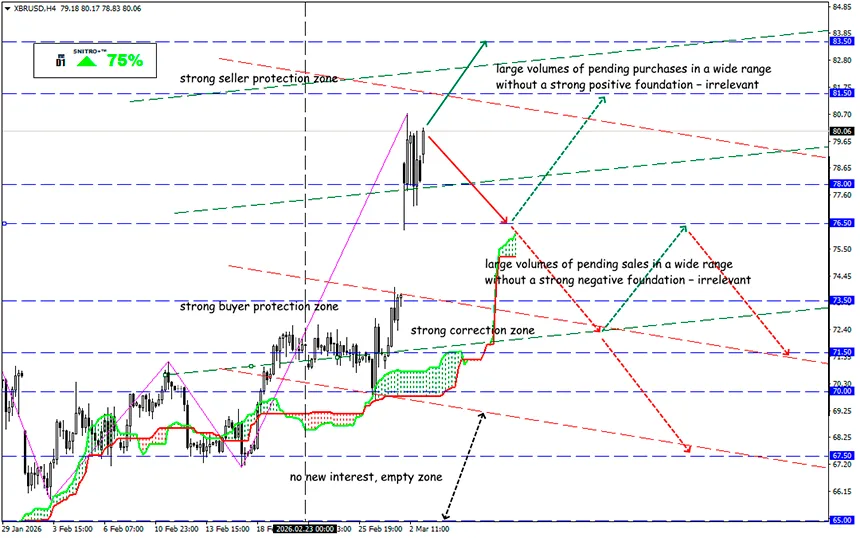
XBR/USD
Key zone: 78.00-80.00
Buy: 81.50(on a confident breakout of the 81.00 level); target 84.00-85.50; StopLoss 80.80
Sell: 78.00(on a strong negative fundamental); target 75.50-73.50; StopLoss 78.70
Markets are attempting to recover after Trump stated that the military conflict in the Middle East would continue “until all necessary objectives are achieved.” A period of 3–4 weeks of active offensive operations is already being perceived as the norm. All of this increases pressure on risk assets and pushes oil, gold, and the dollar higher.
Reminder:
The main US accusation against Iran is its armed and financial support of terrorism, interpreted as a violation of international law and a threat to the security of US allies. Iran’s research into nuclear weapons development is viewed as a separate and serious threat. Eliminating this capability, as part of a broader military strategy, is intended to restore regional stability and curb the spread of extremism.
Inspired by the rapid success of a nearly identical situation in Venezuela, Trump offered the Iranian government a solution now commonly referred to as the “Maduro option.” But the gambit failed, and military action followed.
The armed conflict has already affected neighboring countries and is increasing destabilizing pressure on financial markets.
- Fuel prices have already risen by 14–25%.
- Tanker traffic through the Strait of Hormuz, which handles about 20% of global oil and gas supplies, has stopped.
- In Europe, natural gas prices surged after QatarEnergy halted production.
- A major Saudi Aramco refinery came under attack and suspended processing operations for security reasons.
- Iraq today reduced oil production at the Rumaila field by 700K barrels per day and also halted output of 460K barrels per day at the West Qurna-2 field.
- The UAE reported a major fire at a refinery in Fujairah caused by drone debris.
- The IEA is ready to release oil reserves to stabilize the market situation.
The slowdown in maritime transport is raising concerns about storage overflow in the region, which could lead to production cuts.
Meanwhile, Saudi Aramco is considering increasing shipments through the port of Yanbu on the Red Sea, located outside the Persian Gulf. This follows the fact that dozens of vessels are stranded due to the effective closure of the Strait of Hormuz.
Typically, Saudi Aramco exports most of its oil through Persian Gulf ports. However, recent disruptions have led to congestion and the de facto shutdown of the Strait of Hormuz. The company operates a 5 million barrel-per-day pipeline running across the country, enabling transport of oil from eastern fields to the Red Sea in the west.
At today’s market open, the lack of further oil price growth after yesterday’s initial spike fueled risk appetite, and stock indices surged. But strengthening bullish momentum during the session triggered a second wave of risk aversion. Fears of a prolonged closure of the Strait of Hormuz are intensifying, and in the event of extended military action, the US could ban Iranian oil exports, causing a sharp price spike — the most pessimistic analysts see a $100–120 range.
There is a market view that a sharp oil price increase could stop Trump, but until that point, nothing and no one will.
Until tensions ease, any trading operations will be extremely risky. The volume of speculative capital in the market is excessive. Entering positions amid such volatility is possible only with strict risk management and thorough fundamental analysis.
So we act wisely and avoid unnecessary risks.
Profits to y’all!


