



Chaos instead of peace
How politics sustains war
EUR/USD
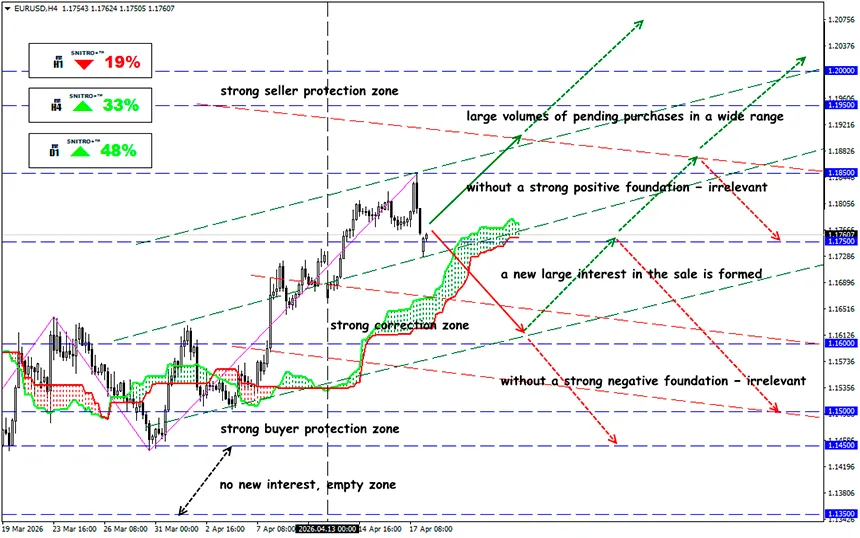
Key zone: 1.1650 - 1.1800
Buy: 1.1800 (on a confirmed break of 1.1750) ; target 1.2000; StopLoss 1.1740
Sell: 1.1650 (on strong negative fundamentals) ; target 1.1500; StopLoss 1.1720
Last week exposed a critically low level of logic in decision-making within the administration of the 47th President of the United States.
Throughout the weekend, Washington and Tehran were engaged in discussions: when negotiations would take place, who would lead the negotiating teams, and other details. As a result, Iran officially refused to hold a second round of peace talks and withdrew from the agreement on “limited commercial transit” through the Strait of Hormuz.
Since Saturday morning, at least three commercial vessels have been attacked, effectively nullifying all security guarantees.
In the morning, Trump threatens the total destruction of Iranian civilization, and in the evening announces a ceasefire. He declares the Strait of Hormuz “permanently open,” but within hours shifts to imposing a blockade. This inconsistency points to a painful search for a way out of the war that can be presented to voters as a victory.
In less than 24 hours, Donnie posted a record 58 tweets — ranging from “good news” about Iran to his usual attacks on opposition media and references to the 2020 election.
Fear of political defeat completely destroys rational thinking.
- Trump is rushing to close the Iran issue before his administration becomes entangled in endless congressional investigations and impeachment proceedings.
- Hearings in the U.S. Senate Banking Committee on confirming Kevin Warsh as Federal Reserve Chair begin tomorrow. Until a new chair is confirmed, Powell can remain in office. Trump will try to resolve this issue, as he needs lower interest rates ahead of the November congressional elections.
- Trump understands the scale of the threat: if the war does not end soon with a “victorious” peace, high gasoline prices and inflation will turn the November elections into a political disaster for Republicans.
- U.S. Treasury Secretary Bessent publicly opposes reinstating the general license for Russian oil exports.
- At the same time, Trump formally extends the state of emergency for another year, but in reality the picture is different: on April 17, OFAC issued a new license 134B. This document effectively allows operations with Russian oil via tankers until mid-May, creating a situation where the Treasury’s “right hand” does not know what the “left hand” is doing, while the market frantically tries to preserve capital.
Washington is cornered: inaction will signal weakness of the blockade, while decisive action could derail negotiations from which Trump expects a victory.
Without a deal with Iran, it is impossible to stop its nuclear program or, more critically for U.S. domestic politics, restore free navigation. Meanwhile, the strait declared “open” remains de facto closed.
- The longer the Strait of Hormuz remains closed, the higher fuel prices rise in the U.S., pushing Republicans closer to a catastrophic defeat in the November elections.
- The escalation of the Middle East conflict has driven a sharp rise in energy prices, threatening Europe’s economic recovery. A real inflation wave will hit in the coming months as logistics and energy costs are fully passed on to final goods.
- The economic audit of 50 days of conflict looks catastrophic: the global market has already lost more than 500 million barrels of oil, and total damages exceed $60 billion. The sharp drop in production in the Persian Gulf has triggered a global shortage of aviation fuel and petroleum products.
Right now, the market is actively voting against the dollar. This deadlock is making investors doubt the reality of de-escalation, especially since the “open” status of the strait lasted less than a day. Even if the hot phase ends tomorrow, rebuilding destroyed infrastructure will take years.
So we act wisely and avoid unnecessary risks.
Profits to y’all!


