



Caribbean oil: a $100 billion gamble

Speculators are in vain waiting for a commodity price rally
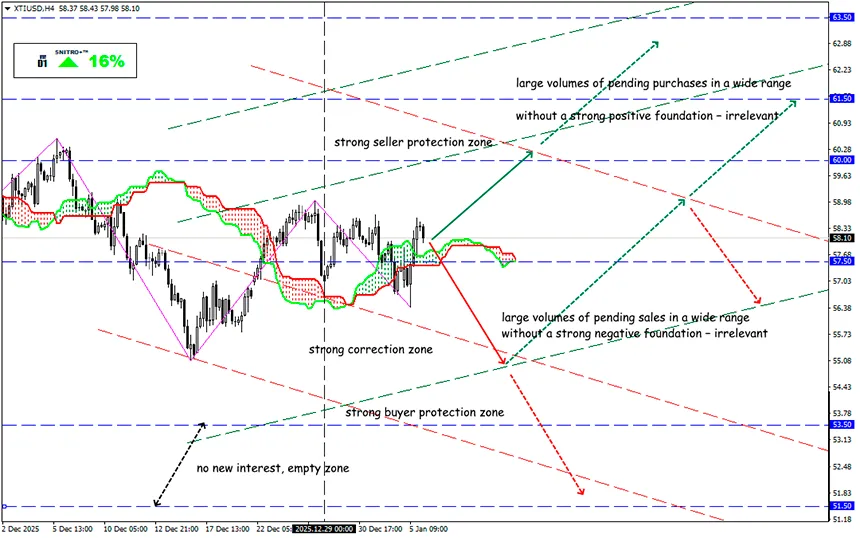
XTI/USD
Key zone: 57.50 - 58.50
Buy: 59.00 (on strong positive fundamentals); target 61.50-63.50; StopLoss 58.30
Sell: 57.50(on a pullback after retesting the 58.50 level); target 55.00; StopLoss 58.20
U.S. media are actively promoting the narrative that Trump attacked Venezuela not because of its “heavy” oil, which requires specific processing, but due to massive external debt, drug trafficking issues, etc. However, the world understands that the primary target is the largest proven oil reserves on the planet — around 303 billion barrels.
OPEC+ chose not to take risks and confirmed oil production cuts in the first quarter — the situation with Venezuela needs clarification. Exports from the region remain paralyzed; loaded tankers are not being released from the zone of military control.
Caribbean oil will not flood the markets immediately, if only because its extraction requires more expensive infrastructure and logistics. Years of corruption, underinvestment, fires, and theft have left the country’s infrastructure in a deplorable state. Venezuela currently produces around 800K barrels per day, but if sanctions are lifted, output could increase by approximately 150K barrels per day within a few months. Returning to levels of 2 million barrels per day or higher would require industry reforms and large-scale investments.
Let us recall:
During the prolonged shutdown, the U.S. CFTC did not publish data on large speculators’ positioning, and after it ended, it took a long time to conduct a full analysis of the situation. The statistics are now relevant again and indicate that speculators are actively buying commodities and/or related assets, such as commodity currencies dependent on oil.
Capital inflows into commodity ETFs were observed throughout the past year, and the same may occur again. The attractiveness of commodity assets is driven by elevated inflation and geopolitical instability.
Trump’s statement that Washington will dictate terms to Venezuela’s new leaders increased the likelihood of a corporate race for access to oil resources. Nevertheless:
- ExxonMobil, Chevron, and ConocoPhillips responded cautiously to Trump’s call due to political instability, Venezuela’s negative history of asset expropriation, and the enormous sums required to ramp up production.
- Chevron, which already operates in the country under a special license granted by the Trump administration, is considered the most suitable producer to increase investments. However, the company stated that it is focused on employee safety and asset integrity.
- Although Trump left the door open to producers from other countries, this does not apply to America’s adversaries. China is the largest buyer of Venezuelan oil, and its companies, like Russian ones, will not be able to access this market.
- Many companies have still not been paid billions of dollars in loans and compensation after their assets were seized under Chávez. Nevertheless, oil companies may return if prices and risk premiums are attractive.
So what is the outcome?
The world is oversupplied with oil, and prices are hovering near a five-year low. The market is strongly hoping for a limited impact of the conflict on global prices.
However, a suspension of oil exports — including tankers insured by PDVSA’s main partner, Chevron — could accelerate the need to cut production at oil fields.
The emotional reaction to Maduro’s arrest has little impact on prices, but it nevertheless serves as a bullish signal for the U.S. stock market and crypto — America has obtained a powerful tool for containing inflation in the form of the world’s largest oil reserves, which it has effectively expropriated. Incidentally, Venezuela also has large gold reserves and even rare earth metals.
For now, short-term price forecasts for 2026 remain unchanged — average Brent at $58–60, WTI at $52–54.
Over a 6–12 month horizon, downside risks for major benchmarks are increasing due to rising global supply.
So we act wisely and avoid unnecessary risks.
Profits to y’all!


