



Capital is shedding illusions

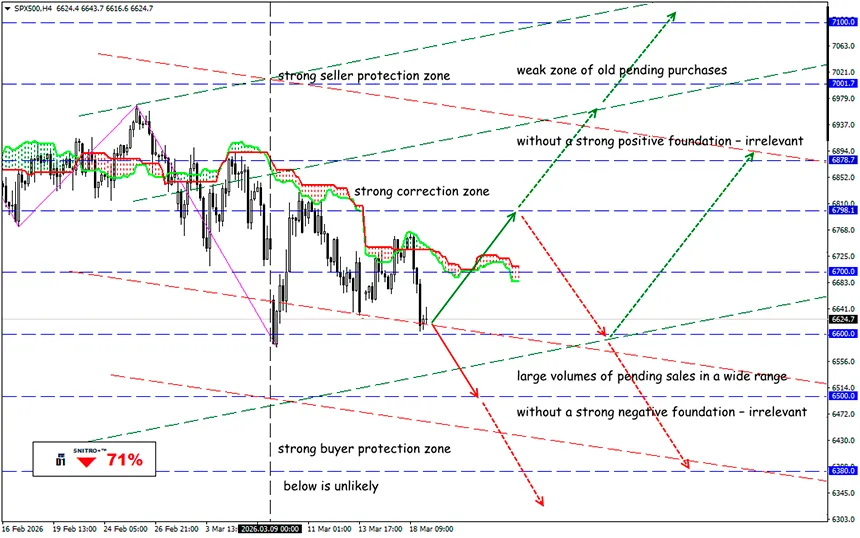
The market resists geopolitical pressure
SP500
Key zone: 6,600 - 6,700
Buy: 6,750 (on strong positive fundamentals); target 6,900-7,050; StopLoss 6,680
Sell: 6,550 (after a decisive break above 6,600); target 6,350; StopLoss 6,620
The U.S. stock market is reacting to macroeconomic signals — virtually everyone prefers to remain in the “red zone”. The indices are clearly pointing downward, as the Fed is giving investors no hope for a quick return of cheap money.
Because of $100 oil and new tariffs, inflation has proven to be too persistent.
The Fed is in no hurry to ease conditions, as it believes the real economy is in good shape. GDP forecasts have been revised upward thanks to strong business productivity. Even the pause in job creation does not worry the Fed — the regulator attributes it to migration restrictions rather than to an approaching recession.
An additional negative factor for the market was the producer price data (PPI), which came in above forecasts and confirmed inflationary pressure.
Let us recall:
The Fed kept the rate at 3.75% — exactly as the market expected, but the key point is not the decision, but the signal.
Forecasts: only one rate cut in 2026, and another one — no earlier than mid-2027.
The tone of the accompanying statement and the press conference:
- inflation is still above target
- uncertainty in the economy remains
- the Middle East factor is the key risk
Powell confirmed that the Fed’s base scenario does not include a rate hike, but the situation depends too much on external factors.
A significant part of FOMC members are not considering a rate cut this year at all due to tariff risks and the possible impact of rising energy prices on inflation. These expectations coincide with sentiment in the futures market, where skepticism about an early policy easing is also increasing.
Powell admitted that the Fed cannot predict how long the war in the Middle East will last (and how it will end!), what will happen to oil prices, and how they will affect inflation and the economy. But he promised to form a clearer opinion by the next meeting.
By the way, Jay said that he will remain in the Fed’s governing body until the judicial investigation against him is completed, but even after the investigation is finished he may not step down if there is a clear threat to the Fed’s independence. This rhetoric should be seen as an element of political bargaining with Trump in order to close the criminal case regarding the misuse of budget funds.
And what is the result?
The S&P 500 and Nasdaq 100 indices lost about 1%, the Dow Jones fell by about 600 points.
In the corporate sector, Visa and Mastercard shares fell by 3%, setting the tone for the payment services segment. Shares of B&G and Walmart lost more than 2%, reflecting weakness even in defensive sectors.
Signs of cooling in the labor market are partially balancing the situation, leaving room for maneuver within the Fed’s dual mandate. The market is also being pressured by rising yields amid higher energy prices after attacks on Iran’s energy infrastructure.
The Fed is in no hurry to save the markets. Rates will remain high for a long time — and this is the new reality.
So we act wisely and avoid unnecessary risks.
Profits to y’all!


