



Bond crisis as a global threat

What broke in Japan’s economy
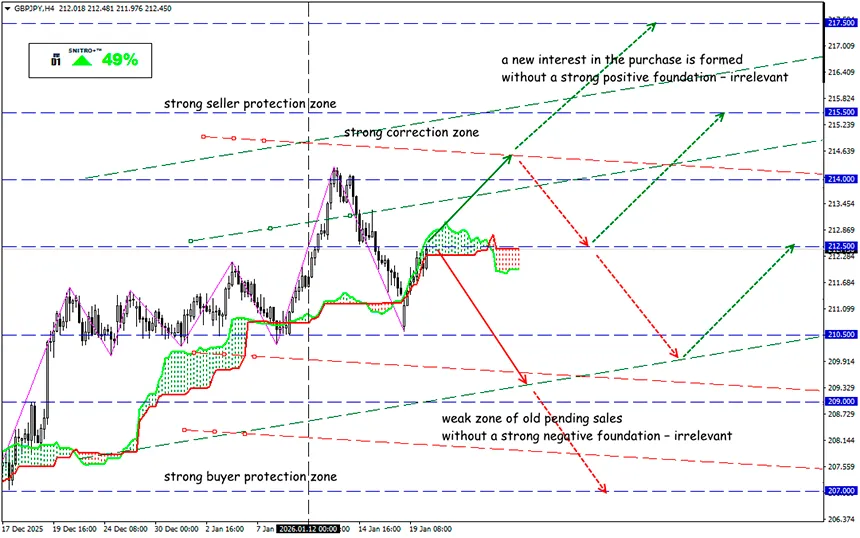
GBP/JPY
Key zone: 211.00- 212.50
Buy: 213.00 (on a pullback after retesting the 212.00 level); target 214.50-215.50; StopLoss 212.30
Sell: 210.50 (on strong negative fundamentals) ; target 209.00-208.50; StopLoss 211.20
Ultra-long JGBs have once again become a “global trigger”: the collapse of Japanese bonds threatens a sell-off of up to $130 bn in U.S. Treasuries. Rising volatility in Japan’s government bond market may spread to other markets, including U.S. Treasuries.
Funds with the same risk profile, evenly allocating capital between equities, bonds, and commodities, may be forced to sell up to 30% of their assets.
The problem intensified last year due to budget concerns, making Japan a key source of global volatility. Several factors are driving the crisis:
- 40-year JGBs rose above 4% for the first time since launch (2007) and traded near a peak of around 4.2%, with the move extremely sharp for the domestic market;
- expectations of fiscal expansion amid snap elections on February 8 and statements on stimulus measures, including Prime Minister Sanae Takaichi’s promise to cut taxes on food;
- structurally low bond liquidity, which in high-risk conditions causes prices to “gap lower” even without massive real selling volumes.
The liquidity index of Japanese government bonds has fallen to record lows, signaling a lack of buyers.
Japan is ceasing to be a “safe haven” — this situation is breaking global risk models.
Reminder:
- Japan is the largest foreign holder of U.S. Treasuries — more than $1,202.6 bn in UST as of November 2025.
- A synchronized repricing of global portfolios involving JGBs negatively affects peers: for every 10 bps increase in Japanese yields, investors may expect roughly a 2–3 bps rise in UST (U.S.), Bund (Eurozone), and Gilt (UK) yields.
- The South Korean bond market is also vulnerable to rising volatility in Japanese government bonds (JGB). Since early July 2024, foreign buyers of Korean Treasuries (KTB) have lost more than 10%, increasing the risk of StopLoss-driven selling.
The BOJ has already raised the rate to 0.75% (the highest level in decades) — a strong psychological break from the era of “zero Japan.” At present, the regulator is trying to normalize policy while preventing “uncontrolled” JGB market dysfunction.
Importantly, the BOJ has an official plan to reduce JGB purchases this year:
- Q1 — reduction of approximately ¥400 bn (the usual pace),
- Q2 — reduction of approximately ¥200 bn.
- Today prices slightly recovered after statements by Finance Minister Satsuki Katayama calling on market participants to remain calm. Notably, U.S. Treasury Secretary Scott Bessent publicly linked UST dynamics to Japanese bonds, meaning the market continues to view Japan as a threat to financial stability.
And what is the result?
GBP/JPY may become more sensitive to Asian news than usual. This pair is a classic asset for carry-trade strategies, where sharp short-term moves against the bullish trend are possible, so StopLoss must be set before opening a position.
At present, the regime is highly conflicted: part of the news pressures the yen due to fiscal expectations and policy (i.e., JPY may weaken), while simultaneously rising volatility/yields can trigger risk-off and JPY strengthening. The British factor has minimal impact on this pair.
So we act wisely and avoid unnecessary risks.
Profits to y’all!


