



BOJ at a dead end: waiting for another intervention
The Japanese yen falls to a 40-year low
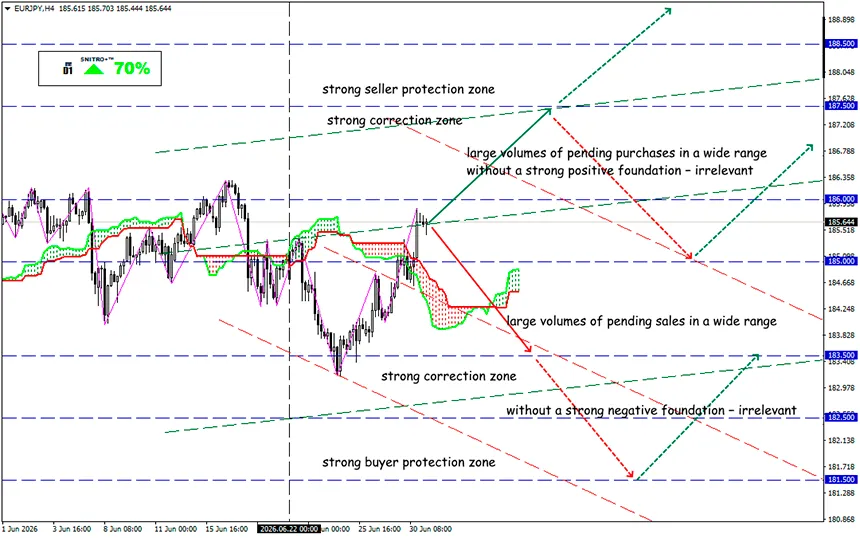
EUR/JPY
Key zone: 185.00 - 186.00
Buy: 186.30 (against a strong positive fundamental backdrop); target 188.50; StopLoss 185.60
Sell: 185.00 (on a pullback following a retest of 186.00) ; target 183.00-182.50; StopLoss 185.70
The yen's decline to 162 per U.S. dollar supports expectations of further weakening of the Japanese currency. The 165-per-dollar level is now being viewed as the potential threshold for intervention by the monetary authorities. Japan's intervention framework continues to evolve in response to the current market environment. Increasingly, the Bank of Japan's decisions to enter the market are determined by the speed and disorder of market movements rather than by fixed exchange-rate levels, as markets have become accustomed to weaker policy signals.
Reminder:
In April and May, Japan spent a record ¥11.7 trillion on currency interventions. Unlike previous episodes, the BOJ is likely to avoid intervening at current levels, where such measures may have only limited impact. Earlier attempts to halt the yen's decline proved ineffective, while the strength of the U.S. dollar continues to be supported by high interest rates and geopolitical tensions.
- Early verbal warnings have lost their effectiveness, making a strategy of deliberate uncertainty more useful in restoring the element of surprise.
- Finance Minister Satsuki Katayama has once again stated that the authorities stand ready to respond to excessive exchange-rate fluctuations. However, verbal interventions have failed to ease pressure on the yen. The currency's depreciation accelerated after Sanae Takaichi came to power in October last year and was further intensified by the war involving Iran, which pushed oil prices higher and worsened Japan's terms of trade.
- The Bank of Japan's interest-rate hike came too late, and the yen is now largely dependent on the strength of the U.S. dollar and expectations of further rate hikes by other central banks.
- If the yen continues to weaken toward the 165 level, Tokyo may resort to direct market intervention.
- The accumulation of short yen positions could ultimately work in Tokyo's favor if intervention occurs, as investors would be forced to buy back yen in order to close their positions. The consequences could be substantial.
A decisive factor could be coordinated intervention by the United States and Japan, as provided for in the joint statement signed in September last year. The probability of such action increases, especially if a move above 163 yen triggers momentum toward the 165 level.
Another major source of pressure on the yen will be the upcoming U.S. labor market report, which could strengthen expectations of additional Federal Reserve rate hikes and further support the U.S. dollar. Historically, Japan has often used periods of thin holiday trading to conduct currency interventions.
The market has already priced in a high probability of further Federal Reserve interest-rate increases. Although many analysts believe the Fed may eventually look past higher inflation, there is currently no immediate catalyst for such a shift. However, softer economic data or a change in the Fed's rhetoric could accelerate this process.
The yen is expected to decline by another 2% during the second quarter, marking its fourth consecutive quarterly decline and the longest losing streak in the past four years. The persistent interest-rate differential continues to weigh heavily on the Japanese currency.
What does this mean?
The EUR/JPY currency pair has entered a zone of uncertainty where two opposing fundamental trends intersect: the European Central Bank's hawkish stance and the growing risk of currency intervention by Japan. Short-term prospects will depend on developments at the ECB Forum in Sintra, eurozone inflation data, and, most importantly, the rhetoric of Japanese officials regarding the possibility of market intervention.
So we act wisely and avoid unnecessary risks.
Profits to y’all!


