



Binance is changing the rules of the game
Why invest millions in a former competitor
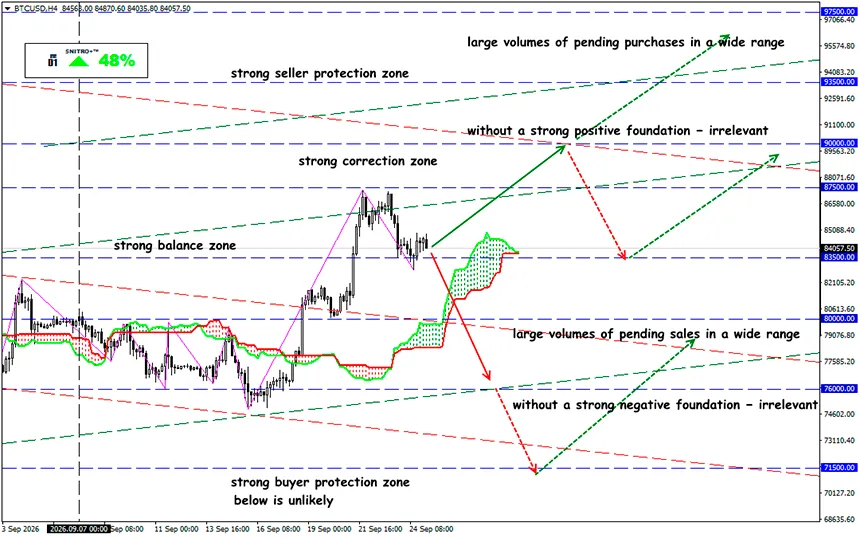
BTC/USD
Key zone: 83,500 - 87,000
Buy: 87,500 (on a pullback after retesting 85,000); target 90,000-91,500; StopLoss 86,500
Sell: 83,500 (on strong negative fundamentals) ; target 80,000; StopLoss 84,500
Binance invested $100 million in Circle and secured a five-year alliance centered around USDC. The deal demonstrates a new stablecoin business model: the exchange monetizes distribution and liquidity, while the regulated issuer takes responsibility for reserves, redemption, and compliance.
At an early stage, the crypto industry followed a simple logic: a major exchange should have its own dollar-denominated token. Now regulation is gradually dividing the market into two specializations — regulated issuers and global distributors.
A reminder:
Just four years ago, Binance was effectively pushing USDC out of its own trading ecosystem in favor of BUSD. Now the world’s largest crypto exchange is investing $100 million in the issuer of USDC and committing to support the stablecoin’s distribution for five years.
On September 17, 2026, Circle and Binance entered into a new five-year commercial agreement that replaced the previous arrangements from November 2024 and August 2025. The deal was publicly announced on September 22.
This is more than just a reversal in corporate strategy. The Binance-Circle deal shows how the stablecoin business itself has changed: after tighter regulation, owning distribution may prove more profitable for an exchange than owning the issuer.
Binance simultaneously acquired 1,237,011 Class A shares of Circle Internet Group (NYSE: CRCL) at $80.84 per share. The total value of the transaction was $100 million. The placement price implied an approximately 5% discount to CRCL’s market price before the deal closed.
This is no longer an ordinary partnership between an exchange and a stablecoin issuer.
Binance gained a direct economic interest in Circle’s growth. At the same time, the commercial agreement provides that Circle will pay Binance a monthly fee calculated as a percentage of the volume of USDC held through the Modular Smart Contract Wallet infrastructure. Binance, for its part, must promote USDC on its own platform.
Circle shares also cannot be freely resold immediately after the transaction. Binance agreed, for a period of up to two years, not to sell, transfer, pledge, or hedge the acquired stake, except in specified cases. Voting rights are retained.
In other words, the $100 million looks less like a short-term financial investment and more like part of a broader commercial alliance.
A modern dollar-denominated stablecoin is far more than just a smart contract.
It requires reserve assets, banking partners, liquidity management, issuance and redemption procedures, reporting, licenses, AML/KYC infrastructure, and compliance with the requirements of multiple jurisdictions.
This is precisely the part of the business that Binance is now effectively leaving to Circle.
- Circle manages issuance.
- Circle pays for access to this network.
- Binance manages distribution.
- Binance receives a stream of fees while simultaneously owning Circle shares.
The new agreement allows Binance to monetize what it actually possesses: users, trading volumes, wallets, liquidity, and global distribution.
As of September 24, USDT controlled about 60.3% of the stablecoin market, while USDC accounted for 24.7%. Together, the two largest tokens occupied approximately 85% of the market.
If Binance can increase USDC’s share within its own ecosystem, Circle gains additional issuance and reserve income, while Binance receives commercial compensation and potential appreciation in the value of its investment.
A positive feedback loop emerges:
more USDC on Binance → more assets in the infrastructure → more Circle revenue → higher potential value of CRCL → higher value of Binance’s stake.
At the same time, Binance receives separate payments for promoting USDC.
And What Is the Result?
The Binance-Circle partnership changes the competitive landscape. For Binance, USDC is now transforming from an ordinary listed asset into a strategically important product. Binance is not buying control over USDC. It is buying an economic stake in its growth while simultaneously getting paid for distributing it.
For Circle, this means access to one of the world’s largest crypto liquidity networks. For Binance, it is an opportunity to make money from the digital dollar without becoming its issuer.
So we act wisely and avoid unnecessary risks.
Profits to y’all!


