



Bars or tokens: a tough choice for investors
Tokenized gold — real capital or a scam?
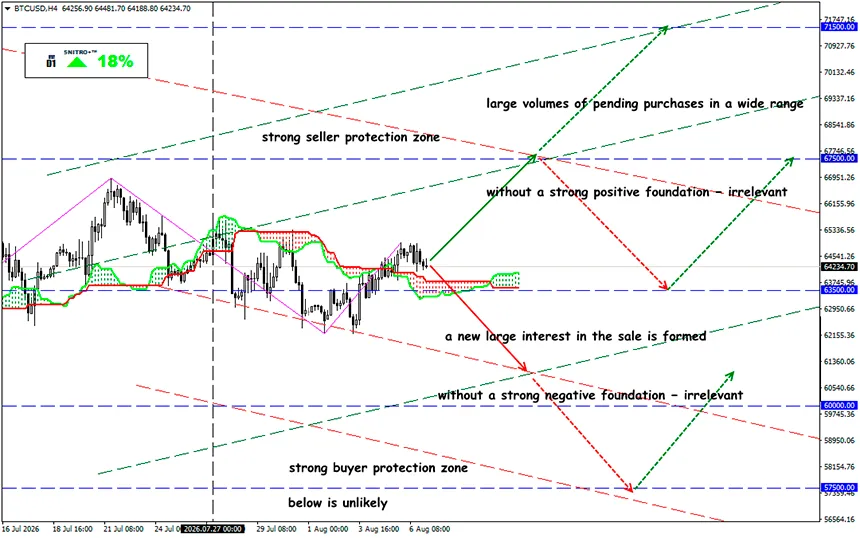
BTC/USD
Key zone: 63,500 - 65,500
Buy: 66,500 (on a pullback after retesting 67,500); target 69,500-71,500; StopLoss 65,500
Sell: 63,500 (on strong negative fundamentals) ; target 60,000-58,500; StopLoss 64,500
Exchange-traded gold has suffered its sharpest quarterly decline in more than a decade. Nevertheless, demand for tokenized gold assets continues to grow. Why are some investors buying digital gold while the price of the metal itself is falling?
Exchange-traded gold has suffered its sharpest quarterly decline in more than a decade. Nevertheless, demand for tokenized gold assets continues to grow. Why are some investors buying digital gold while the price of the metal itself is falling?
Let’s recap:
The second quarter proved extremely difficult for gold investors. The yellow metal fell 14.1%, marking its sharpest quarterly correction since 2013. Nevertheless, Tether Gold (XAU₮), the world’s largest tokenized gold product, reports that the number of tokens in circulation increased by 9.5% over the same period, bringing its market capitalization to approximately $2.84 billion.
Tether analysts believe this resilience reflects something more than speculative short-term buying.
Tokenized commodities now account for roughly $5.5 billion in market capitalization, while spot trading volume in tokenized gold reached $90.7 billion in the first quarter of 2026 alone, already exceeding the total recorded for all of 2025.
But if tokenized gold tracks the same price as physical bullion, why choose the blockchain version at all?
Products such as Tether Gold and Pax Gold represent ownership rights to physical bullion held in professional vaults. Each token is backed by physical gold and is designed to closely track the price of the underlying metal.
- Physical bullion remains the preferred choice for many long-term investors. It does not require a blockchain, a digital wallet, or reliance on token issuers. And such investments certainly look substantial.
- Tokenized gold does not change the underlying asset itself. Instead, it offers access to bullion without leaving the blockchain ecosystem.
But tokenized gold has its own drawbacks.
- Instead of personally ensuring the security of their gold, investors depend on the issuer, the custodian holding the reserves, and the blockchain infrastructure supporting the token. Regular reserve attestations improve transparency, but holders still rely on counterparties for the safekeeping and redemption of the underlying gold.
- Physical bullion eliminates much of this counterparty risk but creates other challenges — storage, insurance, and transportation costs. Neither approach is objectively better. Each serves a different purpose and exposes investors to different types of risk.
- This shift is also attracting the attention of the traditional gold industry. Earlier this year, the World Gold Council introduced a framework designed to standardize digital gold infrastructure and simplify the integration of gold into modern financial markets. Blockchain technology is changing how gold is owned and transferred.
So, what does this mean?
Modern investors are not buying tokenized gold because it behaves differently from physical gold. They are buying it because blockchain technology is changing how gold can be owned and transferred. Neither approach is objectively better. Each serves a different purpose and exposes investors to different types of risk.
Physical gold and tokenized gold are unlikely to replace each other. Instead, they increasingly appear suited to different investors and different use cases. As more traditional assets move onto blockchain networks, the distinction may become less about what people own and more about how they prefer to own it.
So we act wisely and avoid unnecessary risks.
Profits to y’all!


