



A trap for Trump: the Fed prepares for a power shift
The market is trying to assess the Senate hearings
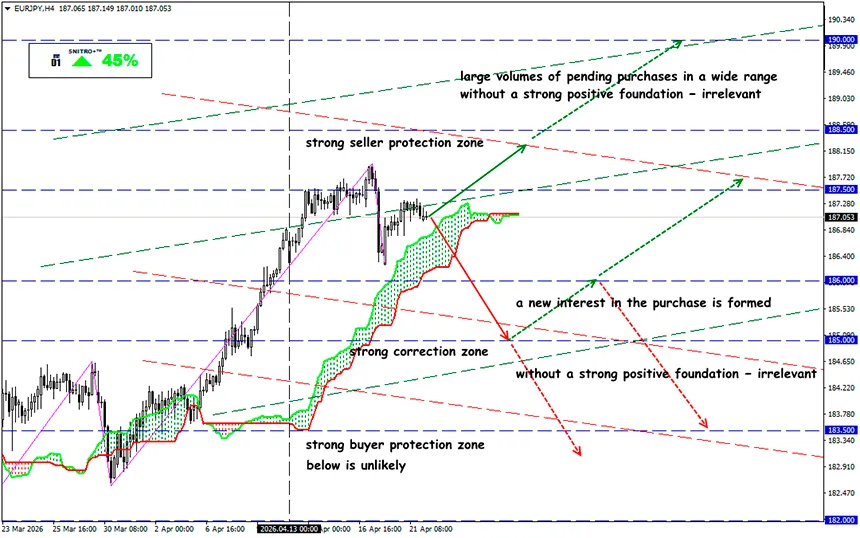
EUR/JPY
Key zone: 187.00 - 187.50
Buy: 188.00 (on strong positive fundamentals); target 190.00-191.50; StopLoss 187.30
Sell: 186.50 (after retesting 187.00) ; target 184.50-183.00; StopLoss 187.20
Republicans in the United States are indirectly supporting a more hawkish Fed policy and preparing a “gift” for Trump. The market is currently speculating not on the actual appointment of Warsh, but merely on the fact of his nomination.
Recall:
The White House formally submitted Kevin Warsh’s nomination to the Senate on March 4, 2026, and the Senate Banking Committee held hearings on April 21. At this stage, there is no final decision; the discussion is only beginning.
The market’s initial verdict was fairly clear: the dollar moved higher, the UST curve steepened, and equities in the financial and technology sectors declined in the short term. The S&P 500 fell by 0.43%, the Nasdaq Composite by 0.94%, the broad dollar index rose by 0.39%, the 10-year UST yield increased by 2 bps, and the VIX rose by 3.3%.
Kevin Warsh’s public profile is a “blend” of strong rejection of all forms of QE and a large Fed balance sheet, combined with a willingness to discuss rate cuts through the logic of productivity and disinflation, if supported by macro data and FOMC consensus.
At this stage, Kevin has stated that he will not be Trump’s “puppet” — which is particularly important in the current political environment.
At its March meeting, the Fed kept the federal funds target range at 3.50–3.75% and emphasized that further steps would depend on incoming data. Meanwhile, March CPI came in at 3.3% YoY and 0.9% MoM, February PCE at 2.8% YoY, and the labor market added 178K jobs in March with unemployment at 4.3%.
In other words, Warsh is being nominated not during a recession, but in an environment where inflation remains above target, employment is not collapsing, and room for aggressive monetary easing is limited.
In his prepared statement to the Senate, he explicitly called monetary independence “essential.” This is important because as of April 15, the Fed’s balance sheet stands at approximately $6.406 trillion, including about $4.407 trillion in Treasuries and $1.996 trillion in MBS.
And what is the result
It is still too early to draw conclusions, but some things are already clear:
- Warsh stated that Trump did not demand firm commitments from him on rate cuts — after this, the most aggressive commentary largely subsided.
- Together with Treasury Secretary Bessent, Warsh is ready to reduce the Fed’s balance sheet ($6.7 trillion) “slowly and thoughtfully.” A smaller balance sheet, in his view, may lead to lower rates.
- He called Powell’s policy a “fatal mistake” regarding inflation. He promises a “regime shift”: new tools, new metrics, and a new leadership team at the Fed.
- Inflation trends, in his assessment, are “improving,” but official data are “imperfect.” He identified an alternative inflation measure used by the Dallas Fed as optimal.
- There was not a single word about the labor market in his speech. Economists interpret this as doubt about the Fed’s dual mandate.
The appointment of a new Fed Chair should not be viewed simply as a signal for rate cuts. It is more efficient to trade the dollar against a broad currency basket and the Nasdaq index against technology sector equities.
Warsh’s appointment will depend on the judicial investigation into Powell. While it is ongoing, Republicans are not ready to vote for him as a bloc. Senator Tillis is blocking the vote until the investigation is completed. The Kalshi prediction market estimates the probability of a Fed leadership reshuffle at 24% by May 15 and 65% by June 30. As long as Powell remains in the chair, market expectations drift toward a more hawkish stance, which is positive for the dollar.
At this point, Warsh has not made any specific commitments regarding the pace of rate cuts, and yield curves immediately reacted with an increase. He still needs to prove that he is truly independent in his views — a very challenging task.
So we act wisely and avoid unnecessary risks.
Profits to y’all!


