



A strong dollar is making the market nervous
Who pressed the red button on june 23
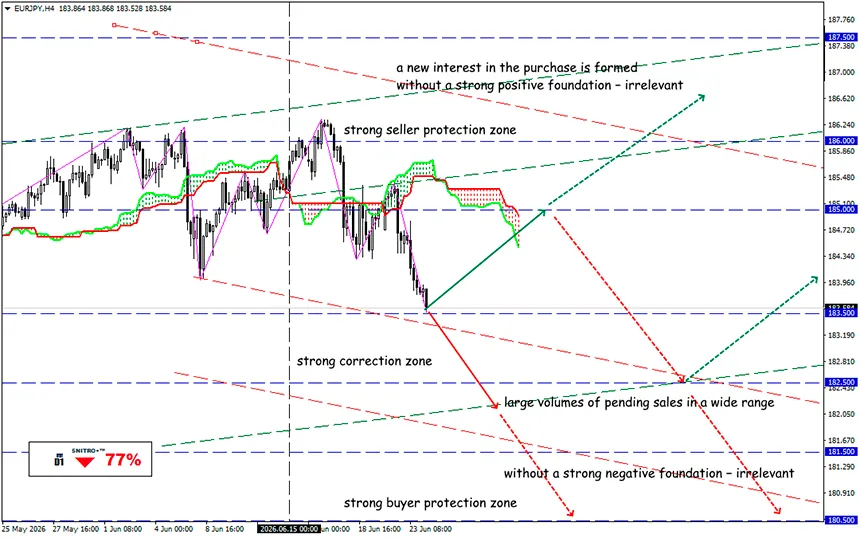
EUR/JPY
Key zone: 183.00 - 184.00
Buy: 184.50 (on a pullback following a retest of 183.50); target 186.50-187.50; StopLoss 184.00
Sell: 182.50 (on strong negative fundamentals) ; target 180.50-180.00; StopLoss 183.00
The market is in turmoil again: in just one trading session, all major global exchanges turned “red.” Everything declined — from the prestigious Nasdaq index to Asian giants and traditional currency pairs. However, this is not a crash but a standard decompression shock amplified by geopolitical manipulation.
The combination of strong U.S. economic data, rising expectations of a more hawkish Federal Reserve policy, and persistent geopolitical uncertainty has once again revived demand for the dollar. The DXY index climbed above 101.5 points, reaching a new annual high.
The trigger for the stock market decline was once again American Big Tech. Investors suddenly began to question whether massive AI investments would really pay off so quickly.
Let us recall:
SpaceX shares plunged by more than 16% after news emerged that the company plans to raise $20 billion through bond issuance. The funds are needed to build AI infrastructure, but the market was alarmed by the scale of the spending. The second event was a talent shortage at Google: key developers from the DeepMind laboratory left for competitor Anthropic. This sparked fears that the technological leadership of major corporations may not be as stable as previously believed. As a result, Alphabet lost 5%, dragging down Amazon, Microsoft, and Meta as well.
In addition, another blow came from the oil market: the United States and Iran unexpectedly agreed on a peace roadmap, and Washington temporarily lifted sanctions on Iranian exports. Supertankers (only two so far) passed through the Strait of Hormuz, while Brent crude plunged below $77. The commodity sector immediately recorded a record capital outflow, and global indices lost stability.
Strong U.S. June PMI data only strengthened the dollar’s position. The composite index rose to 52.2 points, the manufacturing sector is showing its fastest growth in several years, and the services sector continues to expand.
The Federal Reserve has kept rates at 3.50–3.75%, but Warsh’s rhetoric proved ice-cold. This means the market will not see cheap money this year. U.S. Treasury yields surged, and for growth stocks this is always a serious problem.
Asian markets reacted with an avalanche. South Korea’s KOSPI index collapsed by nearly 10%. Automatic trading circuit breakers were triggered twice during the day.
And what is the result?
The panic will fade, but the fundamentals will remain. From a technical perspective, the market is gradually shifting from a phase of uncertainty toward a potential downward reversal. Additional pressure comes from the strengthening dollar and the divergence in monetary policy expectations between the ECB, the BOE, and the U.S. Federal Reserve. The market is once again pricing in a longer period of high interest rates in the United States.
The dollar is receiving strong support from the risk-off environment. Despite some easing of tensions surrounding Iran, the geopolitical premium has not disappeared completely. Any new statements regarding Iran’s nuclear program or inspection issues could quickly return volatility to commodity and currency markets.
In the short term, attention is shifting toward the market’s reaction to corrections: any recovery attempts are increasingly viewed as opportunities to resume selling rather than as the beginning of a new sustainable rally.
If U.S. and European stock markets stabilize, the dollar may move into a stable trading range as traders await PCE index data and further signals from the Federal Reserve that could determine the direction of currency markets through the end of June.
So we act wisely and avoid unnecessary risks.
Profits to y’all!


